The Operator Playbook for a Fully Enforced Security Program Before the Second Invoice
Deploy identity, endpoints, email, and proven backups in your first billing cycle.
A fully enforced security program for a small or mid-sized business starts with decisions. The fastest way to do this is to enforce identity controls, set up the endpoint baseline, add email protection and training, then prove recovery works before the second invoice. A two-week deployment should establish controls that stay active and can be tested.
Why SMBs get hit harder than large enterprises and why the first billing cycle is the highest-leverage moment to close that gap
Small and medium businesses face the same threats as large enterprises without the same security staff, tooling, or response capacity. Attackers exploit that difference deliberately. Weaker defenses, backups that are less developed, and pressure to get back to work quickly make smaller firms easier targets for attackers. Employees also face more social engineering attempts per person than their counterparts at large enterprises, so a smaller workforce does not mean less exposure per head.
The common entry points have known fixes. Stolen credentials, phishing, and unpatched vulnerabilities account for the overwhelming majority of SMB breaches. Yet the cost of recovery does not shrink with company size. Ransomware recovery at a mid-sized firm can run into hundreds of thousands to over a million dollars before any ransom is paid. Organizations whose backups were compromised face recovery costs eight times higher than those whose backups were left intact.
The first billing cycle offers a chance to close those gaps while the founder or IT generalist is focused on the security decision. That attention will not stay available indefinitely. Once routine work takes over, purchased software can become shorthand for protection, and everyone assumes someone else is handling configuration. Enforcement needs to be established during that initial window before operational inertia turns unfinished setup into normal practice.
What a fully enforced security program actually means for a lean operator — and what it does not require
A fully enforced program is a technical condition. Every critical control is on and checked all the time, without someone having to remember to apply it. It requires the tools and processes in place to turn approved policies into running controls. A document requiring encryption does not protect a laptop that ships without it.
For a lean operator, enforcement is usually the gap. Device management must apply baseline settings automatically and flag departures from them. Multi-factor authentication, or MFA, must be required by policy. Offboarding must revoke access in sync with an HR event, even if a help desk ticket arrives three days later.
Recovery belongs in that definition as well. A scheduled backup is not yet a proven recovery asset. Until a critical workload has been restored, the operator has not established that the backup can serve its purpose. The target is therefore not a crowded dashboard or a long policy binder, but a baseline whose coverage and behavior can be demonstrated.
Why the typical first instinct — buy tools, configure later — leaves the program unenforced
Buying advanced tools before the basics are in place leaves expensive tools running on an insecure base. The patchwork is easy to recognize. Device management, endpoint security, compliance, and IT ticketing each have their own console, agent, and reports. Connecting their signals becomes another manual job for a team already short on time. As more alerts come in, real threats can be missed while false alarms take up people's time.
The failure is also one of dependency. Endpoint detection and response, or EDR, cannot replace a patch process that fixes the vulnerabilities generating alerts. Monitoring cannot tell people how to respond if nobody has worked out the steps. Identity policies that depend on device posture need device management to establish that posture before they can decide who should get access.
More tools do not resolve that mismatch. When alerts from disconnected systems overwhelm the operator, reviewing them becomes the work that gets postponed. Protection then exists on a purchase order but cannot keep up with operations. The remedy is to establish the prerequisites for each control before expecting the next one to work.
The ordered sequence — what to put in place first, second, and third within one billing cycle
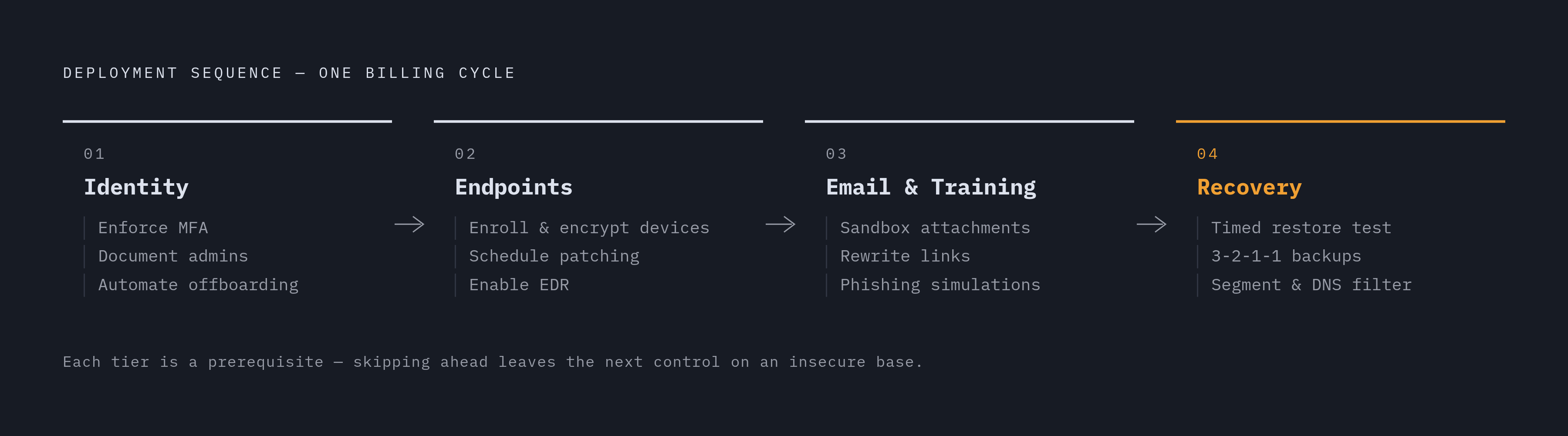
Start with identity because it governs who gets access and how much authority they receive. Make MFA mandatory across critical systems at the policy level, closing a credential-based attack path before adding more complex controls. It is often available within existing software licenses at no additional cost. List every admin account and allow elevated access only where the business need for it is written down. Connect offboarding to HR events so revocation does not depend on someone filing a ticket.
Next, establish the devices those identities use. Every laptop, desktop, and server needs to be visible in device management before its security state can be known. Device management automatically applies disk encryption, screen lock, and the required OS version. Then put patching on a defined schedule. Turn on tamper protection on EDR agents so an attacker cannot simply turn off the protection after getting access.
Only then add the email and human layers. Advanced email filtering uses attachment sandboxing, link rewriting, and impersonation detection to stop threats before they reach the endpoint. That protection serves a different purpose from EDR, which cannot stop an employee from entering credentials into a convincing fake site reached through an unchecked link. Training should begin once identity and endpoint controls are stable because employee judgment is not a substitute for either foundation. KnowBe4 uses baseline phishing simulations, targeted modules for employees who click, and scheduled retesting to track risk over time. Establish a simple procedure for unusual requests, including calling back on a known number to verify them.
Close the sequence by proving recovery and limiting how far an intrusion can spread. Run a timed restore of a critical workload within the first billing cycle. Apply the 3-2-1-1 backup principle with three copies, two media types, one offsite, and one immutable copy so the production attack cannot also encrypt the recovery copies. Network segmentation limits lateral movement from an initial foothold, while DNS filtering blocks known malicious destinations independently of endpoint state. Backup integrity is the closing check because recovery depends on earlier controls to prevent access and contain an attack.
How do you know if your company is actually protected before the second invoice arrives?
Check enforcement at the end of each tier, then review the whole baseline before the second invoice. This is an operator review. The founder or IT generalist needs answers about access, device coverage, recovery, and response.
Begin by checking for any path into a critical system that bypasses MFA. A bypass leaves the identity baseline incomplete. Check whether every active admin account belongs to a named individual with a documented business need. Then run a test offboarding and time how long it takes to revoke access across every system. An unknown result is not evidence of automated offboarding.
For endpoints, compare the fleet with the device management console. Every missing device is a gap in managed coverage. Check for EDR agents that are turned off or lack tamper protection, then check how far behind the fleet is on patches. The number of unpatched devices needs to be visible and tracked.
For recovery, record the timed restore result. For monitoring, identify who would see an alert at 2 a.m. on a Saturday and what they would do. Define and document pre-authorized containment actions, including isolating a device or disabling an account, before an alert demands a decision.
What a consolidated platform does that a patchwork stack cannot — and what to look for when choosing one
A lean operator can execute this sequence manually with five separate tools. Sustaining it is harder. With a patchwork, the operator has to connect device state, identity events, security posture, and compliance status across dashboards. A consolidated platform puts those signals in one console, reducing the reconciliation work between finding a problem and acting on it.
When encryption is disabled, an OS update is missed, or unauthorized software appears, the platform should flag and remedy the drift without waiting for a manual review cycle. HR-connected onboarding and offboarding should synchronize device provisioning and access revocation with employment events. A shared screen alone is not enough. The operating benefit comes from controls that remain enforced as devices and people change.
For a two-week deployment security program, look for setup measured in days. With pre-configured baseline policies, the operator needs to know less to get started, while a blank policy editor leaves that work to the operator. Check cross-OS coverage against the actual fleet, because a platform that reaches only part of it leaves an enforcement gap. Also look for automatically produced, audit-ready evidence to reduce work on customer security questionnaires and a first audit.
Even a short deployment needs a clear plan for what it will cover. Device management and endpoint security deployment are not, by themselves, proof of enforced identity, tested backups, or a viable response path. Evaluate the platform against the sequence and the verification review rather than treating its setup date as the finish line. The right fit for a lean team is a system that reduces the need for specialist work without hiding unfinished controls.
How to handle the controls that will not be fully operational by the second invoice — and what to prioritize next
The first cycle establishes the baseline. Security awareness training begins with a baseline simulation and targeted learning, but a measurable reduction in phishing clicks takes subsequent cycles. Managed detection and response, or MDR, needs a detection baseline so human analysts can distinguish normal activity from deviations. Starting those processes is different from claiming that their long-term results have already arrived.
At the second invoice, rerun the verification review and close the items still open. Do not relabel an unfinished control as future maturity. Missing MFA enforcement or an untested restore is a baseline gap, while improving training results is work that naturally continues over time. Review alert volume and the response record as well. Alerts going unread or taking too long to address show that the response path needs attention before more monitoring is added.
Once the foundations are verified, add depth through pen testing, MDR, or cloud security posture management. That order keeps advanced capabilities from sitting on an insecure base. It also makes the next purchase answer a demonstrated need.
Customers, partners, and auditors increasingly want evidence that controls work. Keeping compliance evidence up to date makes those conversations easier in later cycles. SOC 2, HIPAA, CMMC, and PCI DSS are not first-cycle goals for most lean operators, although the foundational controls here also support the path toward formal compliance. The next stage is to build on that enforced baseline, deepen response, and measure improvement over time.
Sources
- How Automated Enforcement Saves 20+ Hours a Week | Zip Security
- Security Policy Enforcement: Closing the Deployment Gap | Zip Security
- Building a Culture of Security Consciousness: Getting a Security Program off the Ground as a 'Department of One' | Zip Security
- The 3-Step Path to Security Maturity | Zip Security