The Procurement and Change-Control Overhead That Makes Enterprise Security Slow and Why Operators Skip It Entirely
Bloated procurement and change control drive operators to skip security controls entirely.
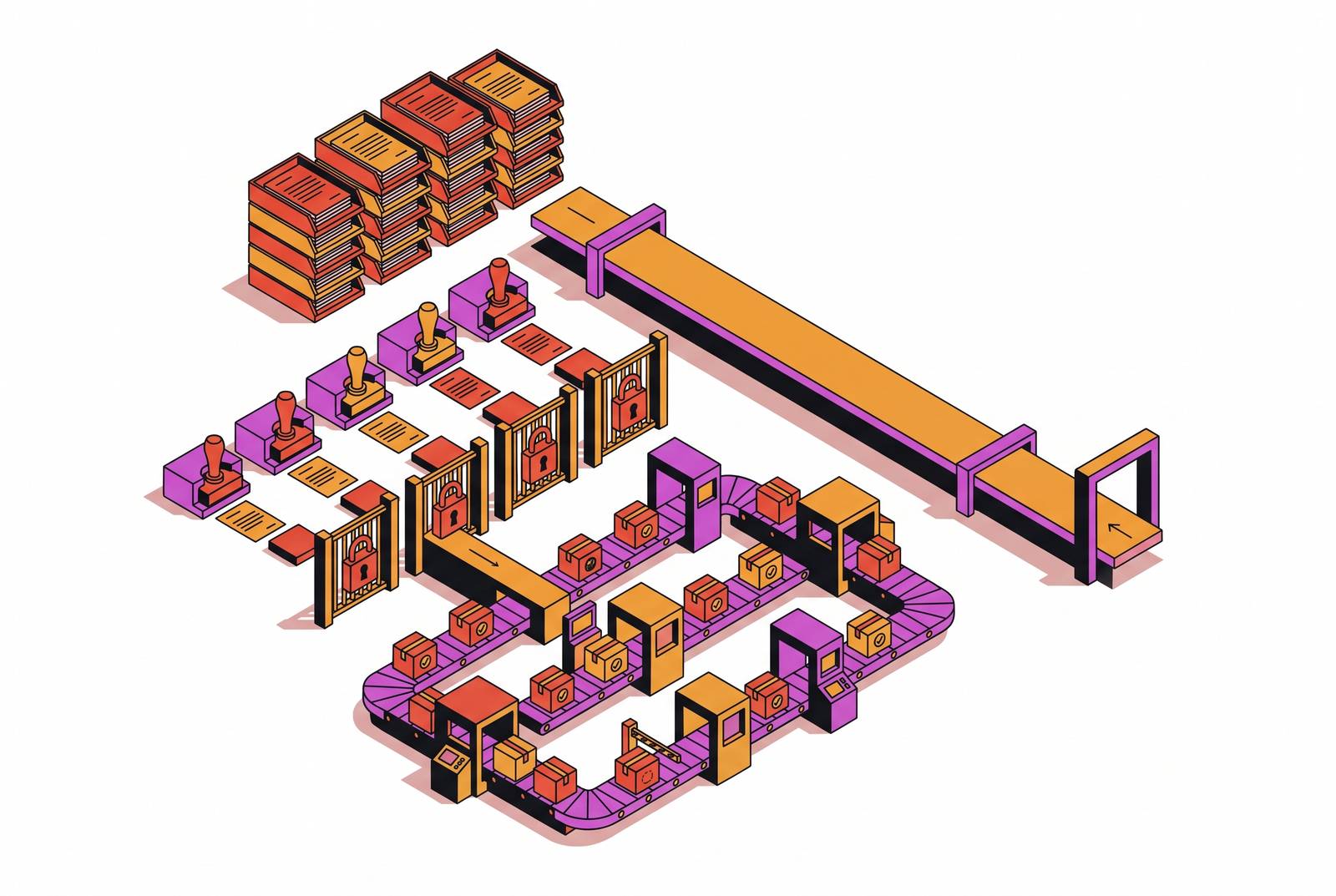
Enterprise security slows down and becomes less reliable when procurement and change control take more work than teams can keep up with. For a small or mid-sized business seeking a two-week deployment security program, the test is whether controls are running and enforced. A lean, integrated program that people can operate is safer than a broader one they routinely bypass.
How enterprise security machinery accumulates weight over time
Enterprise security complexity is often the result of doing the right thing repeatedly until the combined work becomes unmanageable. A new threat justified another tool. A compliance requirement called for another review, while a proven gap in protection called for another vendor. Each decision addressed a real need at the time. Each addition became a permanent layer.
Regulatory pressure has added to that weight. Frameworks and rules including NIS2, DORA, PCI DSS v4.0.1, and the EU AI Act brought new obligations without retiring older ones. DORA applies specifically to EU financial entities and their critical ICT providers. PCI DSS v4.0.1 reached the end of its grace period on March 31, 2025, making its requirements fully enforceable. For affected organizations, meeting a new obligation meant more work on top of the work already required.
The tools and processes acquired through those decisions were assembled as a collection. Each tool may address its assigned problem, yet the organization still has to coordinate its configuration, policies, approvals, and upkeep with everything else. Those connections create their own workload. As the collection grows, the security team must manage both the threats outside the business and the machinery built to deal with them. Buying another capability does not resolve that second problem.
Why the procurement process that was designed to reduce risk now creates it
The procurement layer grows with the stack it governs. Security questionnaires grow to cover each new kind of risk, including AI component governance, supply chain depth, and data residency. They routinely reach hundreds of questions. Answering them can consume months of engineering and legal time on both sides of a purchase, while the most important questions about day-to-day protection remain unanswered. The volume of disclosure grows faster than its usefulness.
AI components make the difficulty especially clear. Buyers need to understand where a model is trained, on what data, and by whom. They also need to know whether it processes customer environment data through a shared inference service, questions with direct EU AI Act implications. These are legitimate concerns. But adding them to an already overloaded questionnaire does not by itself make the resulting answers easier to assess or turn into a sound decision.
Supply chain scrutiny extends the same problem beyond the vendor. A review now reaches into critical suppliers, infrastructure providers, and open-source dependencies. Each additional layer broadens the work needed to understand the purchase. Procurement can therefore consume more organizational energy than the risk decision it is meant to support, even though every question has a defensible purpose.
Rigorous procurement is still better than none. The comparison is between a heavy process that delays decisions for months and a lighter process that can be applied consistently. Delay has a security cost when needed protection cannot be deployed. A review process that produces more paperwork but leaves operational questions unresolved is not reducing risk simply because it is thorough on paper.
How change-control overhead creates the conditions for operators to bypass controls entirely
Change control puts that delay at odds with the work that needs to happen now. It was designed for deliberate, coordinated updates, while threat actors move on a timeline that approval queues cannot match. Legacy approvals, divided governance, and limited integration between tools restrict how quickly controls can be deployed or changed. The operator still has a deadline. A patch, configuration change, or emergency access grant may be needed before the approved process is done.
Automation does not necessarily remove this conflict. An individual workflow can run automatically while the full response remains blocked between cloud, network, and application security teams. The handoff is where progress stops. Each team may have completed its own task, but the next step still depends on another approval or a separate process. This is partial automation rather than coordinated action across the whole environment.
Under that pressure, operators face a choice between waiting and acting without approval. Many choose to act without it. That choice can be understandable without being safe, because the unapproved path leaves the organization without the protection or visibility that change control was supposed to provide. The process becomes something to get around rather than something that helps the work happen safely. Its practical authority weakens precisely when a timely response is most important.
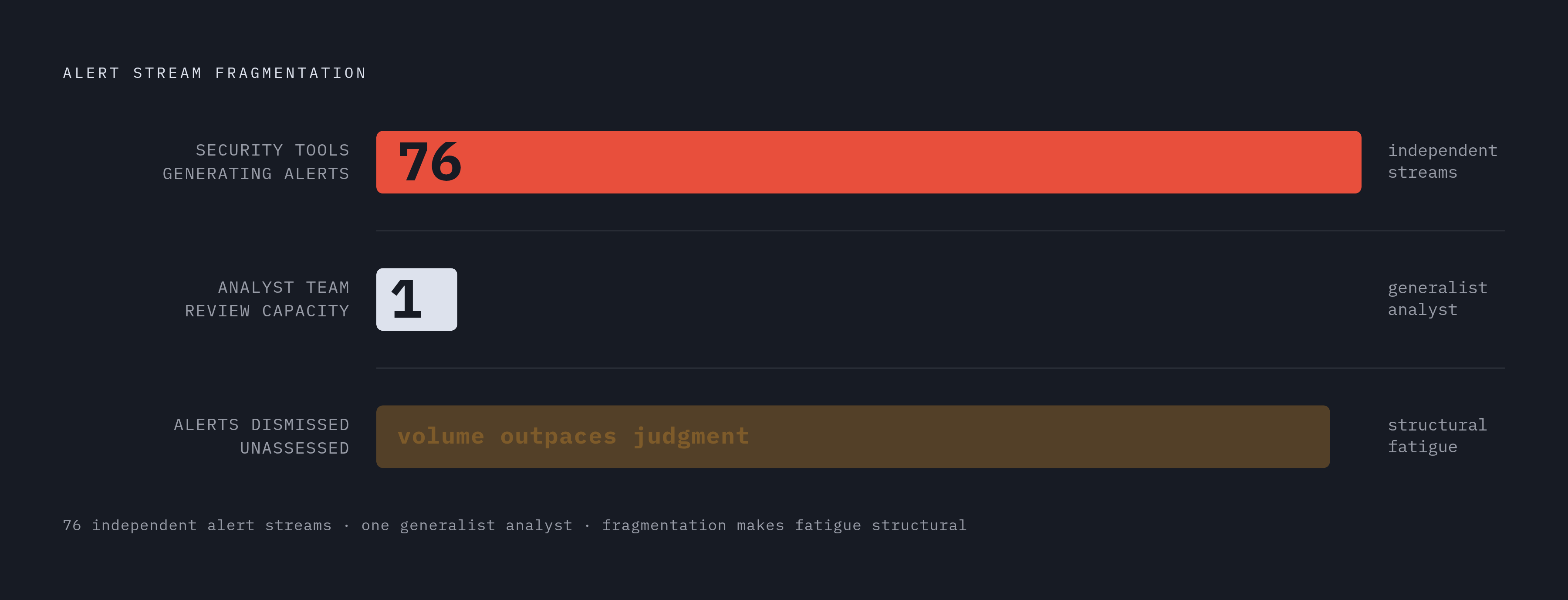
Alert fatigue adds another route to the same outcome. With 76 tools generating independent alert streams, the volume can overwhelm the analysts expected to make sense of them. When they cannot process it all, ease of dismissal can replace genuine risk as the basis for triage.
Even operators who follow the process cannot prevent every gap caused by fragmentation. A policy update applied in one tool can be missed in another, allowing supposedly identical controls to drift apart. Worse, bypassed or unenforced controls can create false confidence. An acknowledged gap is visible as unfinished work, while a control assumed to be active can hide the same exposure behind a claim of coverage.
Why the same dynamic hits smaller organizations faster and harder
Smaller organizations encounter the same workload with fewer people available to absorb it. In an enterprise, a frustrated operator may bypass an established process. In a small business, there may be no specialist available to run that process in the first place. Skipping controls becomes the baseline.
A business owner or IT generalist often takes a DIY approach because someone has to handle security. That person may work hard on each task but still lack the knowledge to design and enforce a program that works as a whole. Cost narrows the options further. Initial and ongoing control costs are frequently viewed as too expensive, especially by micro-businesses, so maintenance competes with the same limited resources that made the initial purchase difficult.
The consequences reach beyond the IT workload. A smaller company with a capable product can lose an enterprise deal because it cannot produce a SOC 2 report, documented controls, or incident response procedures during the security review.
The Verizon 2025 DBIR recorded nearly four times more incidents and confirmed breaches at small businesses than at large organizations. The report attributes part of that difference to the greater number of SMBs in existence, so the comparison is not a measure of an individual company's likelihood of attack. It still undermines the comfort of being small. When ransomware encrypts systems, getting back up and running without paying depends on whether people kept up with backups, even in normal times when nobody was watching.
What consolidation actually accomplishes when procurement and change control are the problem
Consolidation addresses this problem when it removes the coordination work that made enforcement unreliable. The benefit comes from shared signals, consistent policies, and protection that a small team can actually keep running.
Separate tools can each detect part of an incident without showing the whole thing. An alert in one system, a related indicator in another, and a supporting signal in a third remain disconnected when the tools do not share telemetry. Unified platforms can correlate those signals automatically. An attack that begins in email, moves to an endpoint, and then reaches identity may otherwise appear as separate events. Cross-domain detection turns those fragments into a more complete picture.
Policy enforcement improves for a similar reason. When the same policy is configured independently in several tools, each copy becomes another place that needs an update. A platform-level policy layer removes that duplication. There is one place where the policy lives, rather than several versions that can diverge over time. For a generalist, that is a practical reduction in the work needed to maintain consistency.
With fewer vendors, teams also have fewer security reviews, questionnaire cycles, and approval chains to work through when they need changes. That reduction connects consolidation directly to the procurement problem, rather than treating it only as a technical upgrade. It also gives a lean team a more manageable operating model. One platform with one policy layer can be within a generalist's capacity in a way that 76 tools with independent configurations are not.
How do you build a security program your small team will actually follow?
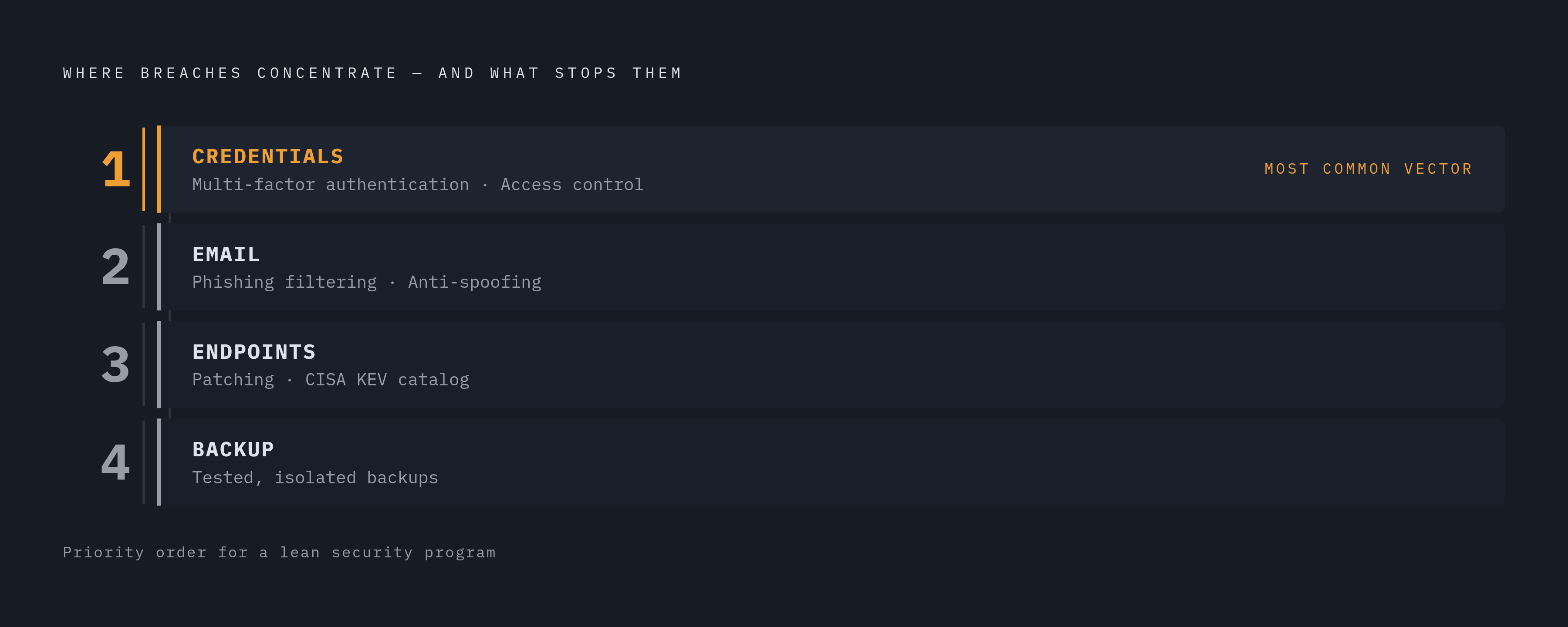
The lesson for a founder or IT generalist is to start with the attack surfaces where breaches concentrate, namely email, credentials, endpoints, and backup. Covering these thoroughly is better than spreading the same resources across a wider set of half-configured tools. Keep the scope tied to operating capacity. A control that the team cannot maintain should not count as reliable protection simply because it appears in the plan.
Begin with multi-factor authentication and access control to address compromised credentials, the most common breach vector. Phishing filtering and anti-spoofing controls reduce the volume of threats that reach the team. That reduction is especially valuable without dedicated analysts. For endpoints, patching discipline needs a clear order of work when the team cannot fix everything at once. CISA's Known Exploited Vulnerabilities catalog provides a stronger prioritization signal than CVSS score alone, because a lower-scored vulnerability actively exploited by ransomware affiliates against edge devices takes precedence over a higher-scored one with no known exploitation.
Make tested, isolated backups a required part of running the business. For an organization without an incident response team, they can enable recovery from a potentially existential ransomware attack. Backup ownership on paper is not enough. Recovery depends on maintaining the discipline behind it.
For a two-week deployment security program, measure speed by the time it takes to enforce controls as well as to finish installation. Deployment speed is a genuine security property. A program enforcing controls in two weeks protects the business during the weeks or months that a more complex rollout would leave it exposed. The available information does not establish a vendor shortlist with proven two-week timelines, so a product ranking would offer false precision.
To assess whether the company is actually protected, look for controls that remain active, consistent, and observable across the environment. An integrated layer for device management, identity protection, and compliance can give a non-specialist a program that stays consistent and can be audited, without that person having to keep separate tools connected. The design principle is straightforward and demanding. Build for the team that must operate the program under pressure.