Why Hackers Target Small Businesses Instead of Enterprises
Enterprise security improvements made small businesses the easier, more profitable target.
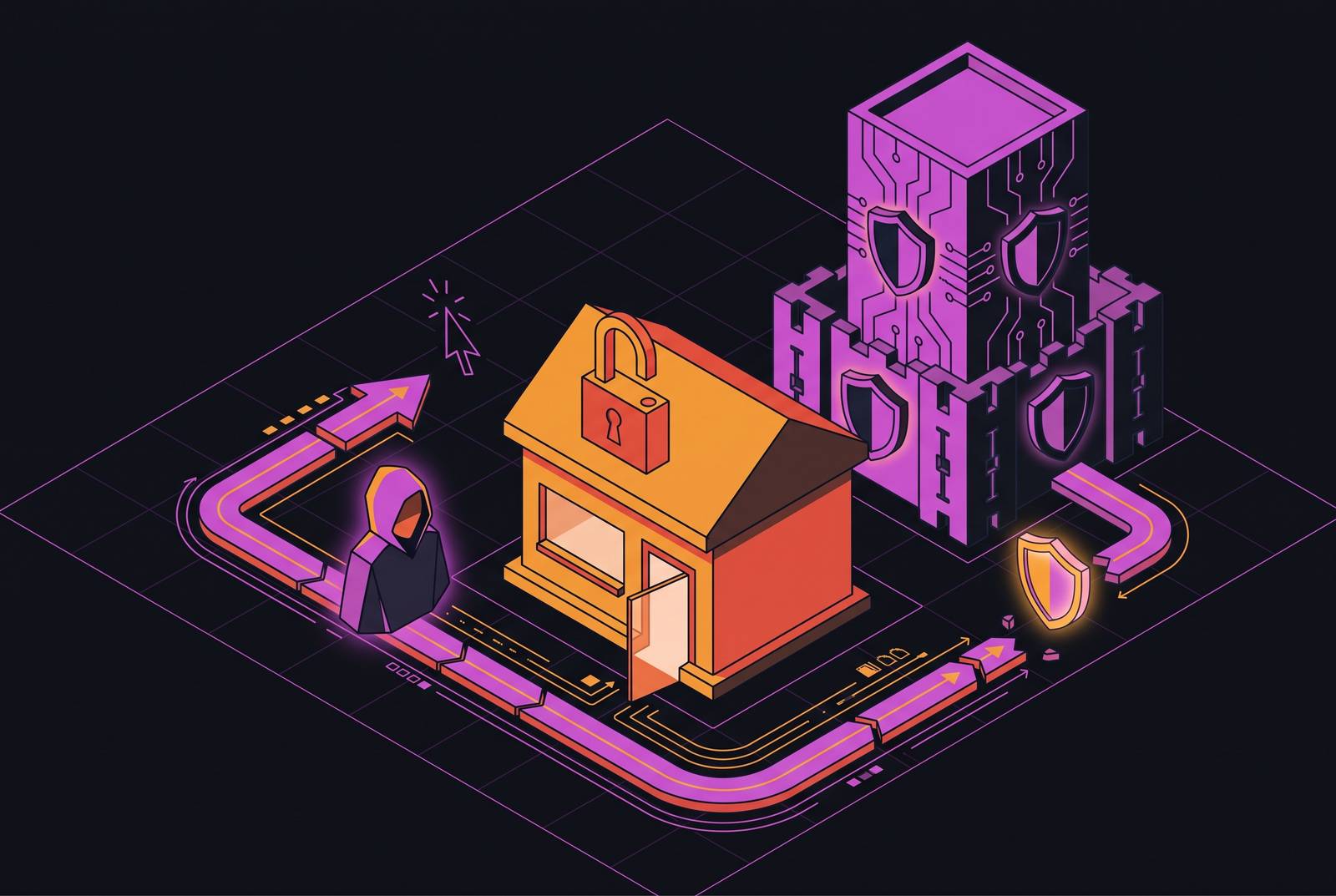
Most small business owners assume hackers want the big score, the enterprise with deep pockets and a payroll department worth ransoming. That assumption is out of date. The economics that used to make large companies the obvious target have flipped, and the reason has nothing to do with mercy toward small operations.
Before 2025, big businesses drew attackers because they sat on the largest pools of money and data. That made sense at the time. But large organizations spent the past few years building out security teams, buying better tooling, and, critically, refusing to pay ransoms as a matter of policy. A business that won't pay stops being profitable to attack, no matter how much a ransomware operator would like to squeeze it, and that refusal is the deciding factor for enterprises now. This shift is fundamentally an economics-of-scale play, as attackers now use automation to target SMBs at scale. A target that won't pay is a target that stops being profitable, no matter how much money it has sitting in accounts.
So attackers moved. Smaller businesses have thinner defenses and a much higher likelihood of paying when hit, and that combination makes volume attacks on SMBs a steadier bet than trying to crack open a hardened enterprise. Automation is what makes the shift work at scale: a criminal running the same script against thousands of small businesses at once turns a target that used to be barely worth the effort into a reliable profit engine. Per Acrisure's analysis, small and mid-sized businesses accounted for 70.5% of data breaches in 2025. That's a direct outcome of a shift in attacker economics, not spillover from enterprise attacks gone wrong. That's the primary target class, chosen on purpose, for reasons that hold up under a plain cost-benefit test.
How automated scanning turns every unpatched SMB into an opportunity
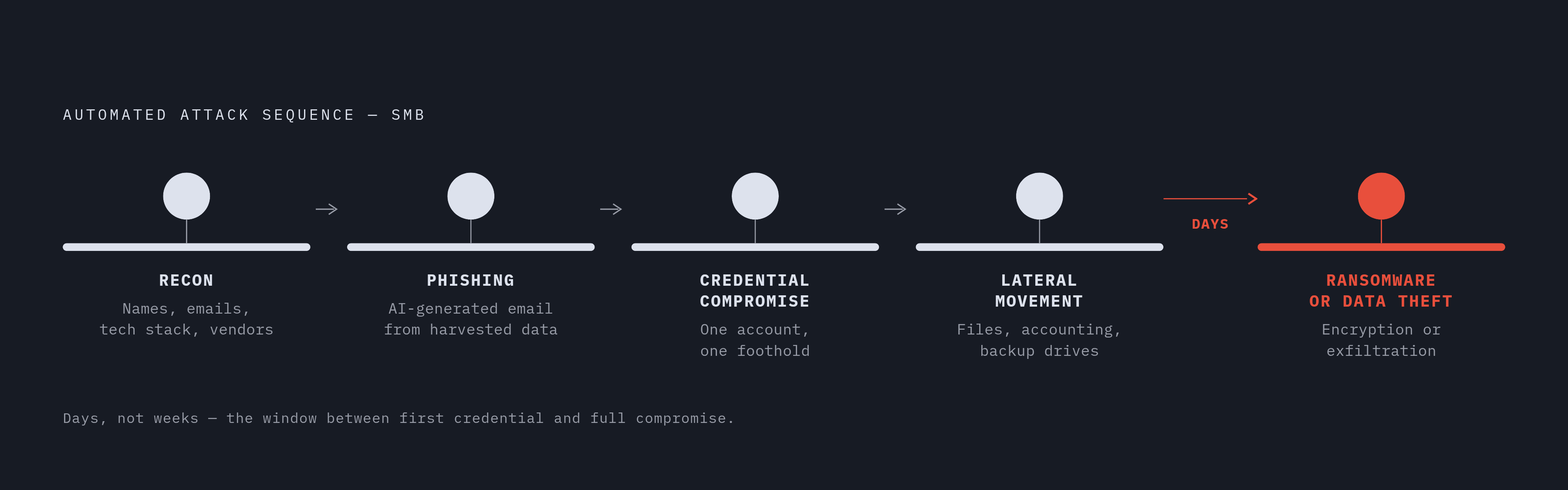
None of this requires a hacker who has heard of a specific company. Most SMB breaches are not handcrafted operations aimed at one target; they're automated sweeps that reward weakness wherever they find it, regardless of who owns the network. Tools crawl the internet around the clock looking for outdated software, exposed databases, weak passwords, and misconfigured servers. Large corporations typically field entire security teams hunting for threats, while smaller businesses tend to be stretched thin, often without dedicated IT staff or even a basic incident response plan in place. When one turns up, nobody checks the company's revenue or reputation first. The exploit just fires.
The process tends to follow the same five steps: reconnaissance, phishing, credential compromise, lateral movement, then ransomware deployment or data theft. Reconnaissance is quieter than it sounds. Automated tools pull employee names, email formats, the technology stack a company runs, and its vendor relationships straight from public sources: the company website, LinkedIn, social posts. That harvested data feeds the phishing emails that follow. Many of these attacks start with a message that looks like it knows too much about the person receiving it.
Once a credential gets compromised, attackers move fast. They head for file servers, accounting systems, and backup drives, and ransomware deployment typically follows within days of that first foothold. Days, not weeks. By the time a business owner notices something is wrong, the lateral movement is often already finished.
Three breaches from 2025 show how this plays out across completely different kinds of small businesses. Tracelo, a mobile geolocation tracking service, had customer names, addresses, phone numbers, emails, and passwords stolen and sold on the dark web by a hacker known as Satanic. PhoneMondo, a German telecom company, lost millions of records, including dates of birth, usernames, passwords, and IBANs, all posted online. SkilloVilla, an Indian edtech platform running with roughly 79 people on staff, had more than 33 million customer records leaked. Different countries, different industries, wildly different company sizes on the small end of the spectrum. What connects them is simpler than any of that: real data sitting behind inadequate defenses. That's the entire prerequisite for automation to do its work.
AI is only making this faster. Adaptive malware, AI-generated phishing that reads more convincingly than the clumsy scams of a few years ago, deepfake impersonation of executives, all of it is rising. And Ransomware-as-a-Service platforms now let criminals with no real technical skill rent attack kits built by people who do have that skill. Three real 2025 breaches illustrate how this plays out across different SMB types.
Three structural features of SMBs that make them reliably profitable to attack
None of this is bad luck. Attackers are exploiting three structural conditions that appear repeatedly across small businesses and are rarely visible inside a hardened enterprise.
The first is thin defenses paired with no dedicated security staff. At most small businesses, technology gets handled by the owner, an office manager, or a part-time consultant juggling it alongside other responsibilities. Endpoint protection is frequently consumer-grade or set up incorrectly, and email filtering leans on whatever comes bundled with Microsoft 365 by default. Budget tells the same story from a different angle: among the smallest businesses, more than half spend less than one percent of their annual budget on cybersecurity. Small businesses hold valuable data, process real money, and typically operate with far less security infrastructure than enterprise organizations, a combination that makes them attractive, accessible, and increasingly profitable to attack. An awareness gap produces that spending gap, too. Most SMBs describe themselves as knowledgeable about cyber risk and say they have a plan in place, yet only about a third are actually investing in new security tools and only a small fraction have adopted any AI-powered defense. An attacker hitting an enterprise runs into layered defenses and a team that responds within minutes; the same automated attack against an SMB often runs into nothing watching at all.
The second structural feature is supply-chain value. A lot of small businesses work as vendors, contractors, or service providers feeding into larger organizations, which makes them a side door into networks that would otherwise be well defended. Compromise the small vendor's email account, and suddenly there's a trusted sender name that customers and partners won't think twice about, which converts follow-on fraud attempts at a far higher rate than a cold phishing email ever would. Most SMBs have no real visibility into their own vendors' security practices either, so the risk runs in both directions and nobody in the chain is watching for it. Breaching a small business, in other words, can be worth more than the business's own data suggests. Sometimes the real prize is whatever larger organization sits one hop away.
The third feature is compliance likelihood: small businesses pay. Backup systems tend to be less sophisticated, incident response plans are rarely tested if they exist at all, and when ransomware lands, paying fast is often the only path back to running the business. A shutdown that a large enterprise treats as a rounding error on the balance sheet can be existential for a small one, and that asymmetry is why SMB owners comply more often. Paying once doesn't end the exposure, either. A meaningful share of businesses that paid a ransom got hit a second time, because criminals keep records of who's willing to pay and circle back.
Financial Consequences for a Business Without a Security Team
None of this stays theoretical for long. A breach at a business without a security team isn't a bad week; it's a financial event that routinely exceeds what the business can absorb, and paying the ransom doesn't close the exposure out.
Ransomware showed up in the vast majority of SMB breaches in 2025, at a rate more than double what large organizations experienced. That gap alone says something about who criminals believe will pay to make the problem go away. But the ransom itself is rarely the biggest line item. Downtime costs, lost productivity, the recovery work, and the reputational damage that follows all dwarf the payment demand. A business can wire the ransom and still spend months rebuilding customer trust and rebuilding systems that were never properly backed up.
Insurance isn't offering much of a safety net anymore, either. A significant share of SMBs saw their cyber insurance premiums spike sharply in 2024, and more than a quarter couldn't get coverage at any price because their security controls didn't meet the bar. That's a market correction happening in real time: insurers looked at the loss data and priced small businesses out, or priced them so high that coverage stopped being a realistic option.
Certain sectors carry more exposure than others. Professional services firms, legal, accounting, insurance, financial services, sit on confidential client data and often have direct access to client financial accounts, which raises the stakes of any single breach. Cybercriminals are increasingly pairing that exposure with AI-powered attacks, ransomware, and phishing aimed squarely at SMBs, which now account for 43% of all attacks.
One popular statistic deserves a direct correction. The claim that a fixed share of small businesses close within six months of a breach has circulated for years, and it has been officially debunked by the National Cybersecurity Alliance. It's worth dropping from the conversation. The real financial numbers, the ransomware rates, the limited insurance access, the downtime costs, make the case on their own without needing an inflated statistic to do the persuading. According to the Verizon DBIR as cited by Sagiss, professional services account for a disproportionate share of denial-of-service victims.
Limits of "Just Get an MSP" for the Underlying Problem
The most common response to all of this, once an owner absorbs the threat picture, is to point at whoever handles the company's IT and say the problem's covered. Often it isn't. Most SMBs that outsource their technology believe they have security coverage, but many don't, because the vendor they hired was built to keep systems running, not to stop a breach.
The distinction between them must be drawn precisely. An MSP, a managed service provider, manages infrastructure and keeps things operating: helpdesk tickets, patching schedules, uptime. An MSSP, a managed security service provider, does something different: monitoring, compliance work, risk management, incident response, and it runs specialized tooling like EDR, SIEM, and SOAR platforms built specifically to catch and contain attacks. Most general-purpose MSPs simply don't staff or operate that tooling. They were never built to.
That gap doesn't announce itself. A dashboard can say "covered" while security enforcement only applies to a fraction of the actual device fleet, and the business has no easy way to tell the difference from the outside. Asking an MSP to also handle security, without changing staffing, tooling, or the metrics used to measure success, doesn't produce security outcomes. It produces paperwork that reads like security.
The market is starting to notice this on its own. In ESET's SMB survey, U.S. small businesses that outsourced security were more likely to pick cyber insurers offering MDR or dedicated MDR vendors over traditional MSPs. Practitioners closer to the problem are drawing a line the broader market hasn't fully caught up to yet. The right question for any owner to ask isn't whether there's a vendor on retainer. It's whether that vendor actively monitors, detects, and responds, or whether it just keeps the lights on.
The controls that close the gaps attackers exploit, in order of impact
The good news, if there is one, is that the controls which actually shift an attacker's cost-benefit math are cheap and simple. They're specific, they're actionable, and most SMBs still haven't fully put any of them in place.
Multi-factor authentication sits at the top of that list by a wide margin. MFA blocks up to 90% of automated account attacks, which makes it the highest-impact security measure available relative to what it costs to deploy. And yet a large share of SMBs still don't enforce it across every cloud service, email account, and remote access tool. AI-driven credential attacks are highly effective against a password sitting alone, but they run into real trouble the moment a second factor gets added. Deployment alone isn't the finish line, though. MFA that employees can quietly disable or route around doesn't deliver the protection it's supposed to; enforcement is what actually counts.
ESET's 2026 SMB Cyber Readiness Index identifies employee training as the top security investment priority, finding that organizations with more frequent, higher-quality training report fewer incidents and faster recovery. The cadence matters as much as the content. Training needs to happen monthly, not once a year, because AI-generated phishing and deepfake impersonation are getting good enough that instinct alone can no longer catch them.
None of this requires an enterprise budget or a security team on payroll.