Cybersecurity Policy Examples for Small Business Compliance
Written policies and assigned ownership turn security tools into verifiable compliance for auditors.
Cybersecurity policy examples for small business compliance need to do more than fill a folder. They need to turn security expectations into rules that employees follow and auditors can test. The main gap is often not missing software but missing documentation and proof. A workable program connects each written rule to an owner, an enforced control, and evidence that the control runs over time.
Why small businesses fail compliance audits despite having security tools
An auditor asks for months of access logs, and the business has no evidence trail. It has multi-factor authentication, or MFA, but cannot show where it was required or whether it stayed enforced. Most small-business compliance failures come from missing documented policies.
The same gap appears when employees use personal devices with no written safeguards, access rules are unwritten, and nobody has set out how to handle sensitive data. The problem gets worse if the business has no incident response plan or its documentation is out of date. More cyber insurers now ask for a written response plan before they offer coverage, so endpoint protection alone may not be enough to get a policy. Missing documentation can mean slower recovery, denied claims, lost enterprise contracts, and regulatory fines.
Which compliance frameworks actually apply to a given small business
Before writing policies, find out which rules the business must follow. The data it handles, the services it provides, and the requirements its customers impose provide a useful starting point. How big the company is does not, on its own, settle the question. In 2026, small businesses serving a given national market face both rules set by law and demands from those they do business with, and the costs of falling short differ.
PCI DSS v4.0 applies to businesses storing, processing, or transmitting card data. Among its core requirements are network segmentation, encryption, access control, and quarterly scans. HIPAA applies to healthcare providers, insurers, and business associates that handle protected health information, or PHI. That can include a scheduling SaaS vendor that handles patient names linked to appointment data, even if the data has no diagnoses. Its evidence must support administrative, physical, and technical safeguards for PHI.
The FTC Safeguards Rule covers non-bank financial institutions, including mortgage brokers, accountants, auto dealers offering financing, and tax preparers. Its central document is a Written Information Security Program, or WISP. CCPA/CPRA applies to businesses serving the covered state above revenue or data thresholds, with requirements for consumer rights, opt-outs, and data minimization. Businesses can face penalties under these frameworks, while other requirements come mainly from contracts with customers.
SOC 2 is not a law but a contractual expectation from enterprise buyers, often brought into focus by a vendor questionnaire. ISO 27001 is a voluntary certification that global partners may require. For these, the immediate consequence is lost deals or contracts. Retail and e-commerce businesses generally map to PCI DSS plus state privacy law, while healthcare and health-adjacent businesses map to HIPAA and often PCI DSS too. Financial services and professional firms map to the FTC Safeguards Rule and GLBA, while B2B SaaS and enterprise vendors commonly face SOC 2 and ISO 27001 expectations.
A med-spa taking card payments can sit inside both HIPAA and PCI DSS. EU-facing activity can also bring GDPR into scope regardless of headcount, though processing an EU citizen’s data outside the EU does not by itself settle applicability. For a general small business with no card payments and no regulated data, state breach-notification law and cyber insurer requirements form the practical floor.
The ten policy documents regulators and insurers actually check
The ten recurring documents are Access Management, Acceptable Use, Data Protection and Privacy, Digital Security, Generative AI, Incident Response, Business Continuity and Disaster Recovery, Personal Information Management, Vendor and Third-Party Risk, and Record Retention and Secure Destruction. Together, they form the documentary backbone of a defensible program. Their value lies in the decisions they record. Each gives an auditor or insurer a defined requirement to examine.
The Access Management Policy requires unique credentials, MFA, and immediate access revocation when employment ends. The Acceptable Use Policy defines approved device and network use, prohibits unauthorized software and risky downloads, and sets email, messaging, and violation rules. That gives the business a written basis for investigating incidents and enforcing expectations. The Data Protection and Privacy Policy covers storage, encryption, access, vendor sharing, retention, and disposal, supporting both privacy obligations and enterprise contracts.
The Digital Security Plan records patch timelines, backup schedules, vendor security standards, and website hosting controls. It addresses operational weaknesses such as unpatched software, a primary ransomware driver. The Generative AI Policy states which tools and data classifications are approved and must at least ban entering confidential or regulated data into public AI platforms. The Incident Response Plan names escalation contacts and covers legal and insurance coordination, restoration, and internal communication. Testing that plan twice annually through tabletop exercises makes it more than an insurance application attachment.
The Business Continuity and Disaster Recovery Policy defines how long the business can operate without key systems. It records backup frequency, storage locations, recovery time objectives, and testing schedules, addressing the common gap between having backups and proving they work. The Personal Information Management Policy records what personal data is collected, why, for how long, and who can access it. That formal record supports multi-state privacy requirements.
The Vendor and Third-Party Risk Policy sets vendor security expectations, data-sharing agreements, compliance requirements, and an ongoing review cadence. It matters because many frameworks hold the business accountable for vendor security failures. The Record Retention and Secure Destruction Policy defines when records expire and how they are destroyed. Its governing principle is simple, namely that data the business does not need should not be stored. Physical safeguards, including clear-desk, clear-screen, and visitor controls, and a public Privacy Notice complete the picture without necessarily becoming separate policies.
What each policy must actually say to satisfy an auditor
An auditable policy assigns a role, sets a measurable standard, and defines a procedure or consequence. Before the policy is adopted, the business needs to fill in the bracketed fields with its own answers, especially for deadlines, data categories, and the roles in charge.
For Access Management, use direct requirements. “Every employee and contractor receives a unique, named account. Shared logins are prohibited. Employees may access only the resources required for their function. [Responsible role] revokes access immediately on termination and adjusts access on the same business day as a role change.”
Then define the authentication and review rules. “MFA is mandatory on email, banking, payroll, accounting, domain registrar, cloud admin, and remote-access tools, without exceptions. Phishing-resistant MFA, including hardware security keys or passkeys, is preferred over SMS codes. [Responsible role] reviews admin accounts monthly and removes unnecessary privileges.” Passkeys over SMS codes are the 2026 best practice for reducing exposure to phone-number hijacking attacks.
For Acceptable Use and Generative AI, make the boundaries explicit. “Devices and networks may be used only for [approved business uses]. Unauthorized software and risky downloads are prohibited. Employees follow [email and messaging rules] and face [defined consequences] if they break them. Only [approved AI tools] may be used with [permitted data classifications]. Confidential or regulated data must never be entered into public AI platforms.”
For Data Protection and Privacy, connect the rule to an actual data record. “[Responsible role] maintains a record of each data category, its storage location, authorized users, access conditions, and vendor-sharing rules. The data in each category is encrypted at rest using [specified method] and in transit using [specified method]. Each category is retained for [defined period] and destroyed using [defined method].” The Personal Information Management Policy adds why each category is collected, while Record Retention and Secure Destruction spells out how to dispose of it.
For Incident Response, give people authority before an emergency. “The plan activates when [defined event threshold] is met. [Named roles] are authorized to disconnect systems, disable accounts, approve emergency spending, contact the insurer, notify customers, and authorize public statements. [Designated role] records every action in the incident decision log.” The plan follows six phases, which are Preparation, Detection and Identification, Containment, Eradication, Recovery, and Lessons Learned.
Notification duties need exact deadlines. “[Responsible role] records and follows the applicable legal and insurance notification deadlines. The plan is tabletop-tested twice annually.” Covered firms must account for the FTC Safeguards Rule’s deadline and threshold for events involving unencrypted consumer information. State insurance regulations that follow the NAIC model generally allow only a short time to give notice after a firm determines that a cybersecurity event occurred.
For Vendor and Third-Party Risk, state what must happen when a vendor joins and when it leaves. “Vendors handling regulated data must meet [defined security standard], including [required SOC 2 Type II report, encryption evidence, or signed data processing agreement]. [Responsible role] reviews vendors on [defined cadence]. When a vendor relationship ends, access is revoked and data deletion or return is confirmed.” Leaving offboarding out leaves a data-handling obligation unresolved.
For the Digital Security Plan, set firm deadlines for the work. “Critical patches are applied within [specific number of days] after release. Backups run on [defined schedule] and are stored at [specified locations], including at least one offline or immutable copy that a compromised admin account cannot reach. Restore tests run quarterly. All laptops use full-disk encryption, all endpoints run endpoint detection and response, or EDR, and personal devices require mobile device management, or MDM, enrollment before production access.”
Complete the operational rules with network and recovery requirements. “A business-grade firewall protects the network. Corporate, guest, IoT, and point-of-sale traffic are separated through network segmentation.” The Business Continuity and Disaster Recovery Policy then states the business limits. “Each key system has a documented recovery time objective and a defined period the business can operate without it. [Responsible role] maintains backup locations, recovery procedures, and the testing schedule.”
How to sequence building the program so compliance evidence accumulates from day one
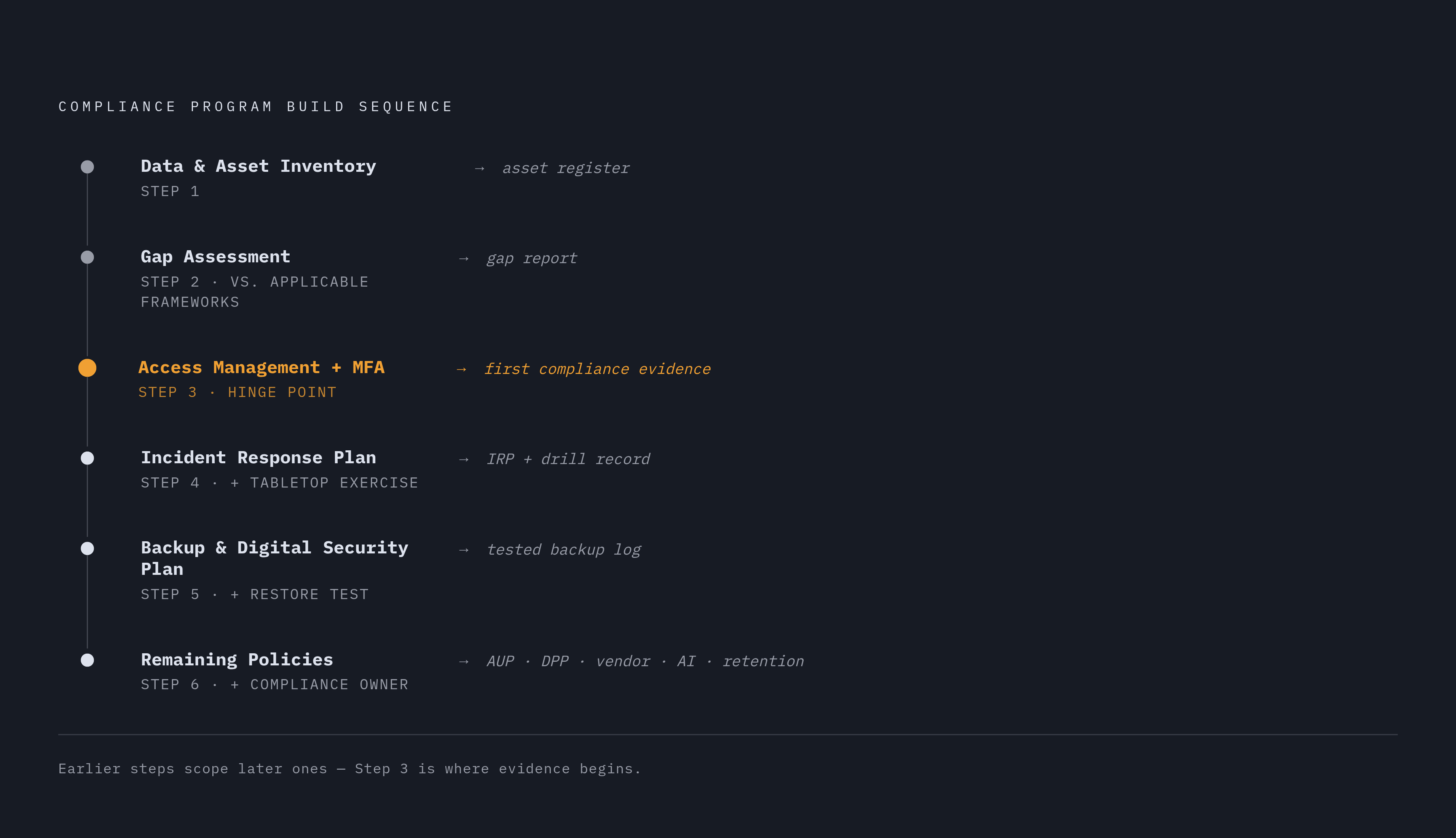
Start with a data and asset inventory, before writing policy language. Record what data exists, where it lives, and which systems touch it. That inventory scopes the documents and becomes Exhibit A at audit. Next, compare the current state with the applicable frameworks. The resulting gap assessment becomes the policy-writing backlog, so work follows actual obligations rather than whichever template is easiest to download.
Build and enforce Access Management first. When the business requires MFA for everyone and revokes unused accounts, it starts to build access evidence right away. Then draft the Incident Response Plan and run a tabletop exercise. The exercise creates a test record that an untested document cannot supply. Follow it with the backup and Digital Security Plan, including the first restore test, because written backup commitments without a test log are insufficient.
With those foundations running, finish the remaining documents, including Acceptable Use, Data Protection, Vendor Risk, Generative AI, and Record Retention. Give each a role responsible for enforcement and review. Then name a compliance owner with authority to say no, whose first act is setting a review calendar that runs at least annually. This makes compliance a program with continuing responsibility rather than a project that ends when the files are saved.
Trying to build everything at once burns momentum, while deploying controls before defining their requirements leaves gaps in proof. NIST CSF 2.0 provides an organizational spine through its six functions, which are Govern, Identify, Protect, Detect, Respond, and Recover. Those functions connect the work across HIPAA’s Security Rule, PCI DSS, SOC 2, and ISO 27001 without requiring separate operational programs for every framework.
Where an integrated security platform fits into a policy-driven compliance program
Once the rules are written, enforcement becomes the next gap. A requirement for MFA does not prove that accounts stayed protected, and a patch deadline does not prove that endpoints met it. Access logs and patch compliance reports provide that evidence. Manual tracking by a founder or IT generalist is where many small-business programs break down. An integrated platform supplies the operational layer beneath the policies.
Device management supports the Digital Security Plan by continuously monitoring encryption, patch state, and MDM enrollment. Identity protection supports Access Management through MFA status, account provisioning and deprovisioning, and privileged account review. Compliance automation turns those operating records into reports that are ready for an audit, so the business avoids a scramble before the audit. Incident detection supports the detection phase of the Incident Response Plan, while the written plan still determines who responds and what authority they have.
Consolidation matters when separate tools overlap but leave no single audit trail. A platform combining device management, identity protection, and compliance automation can unify the evidence under one contract, reducing the manual burden without adding a dedicated security team. The compliance owner still defines expectations and remains accountable for them.
Sources
- Small Business Cybersecurity Checklist: The Controls That Actually Matter | Zip Security
- Security Policy Enforcement: Closing the Deployment Gap | Zip Security
- Cybersecurity for Startups: A Practical Guide to Getting Secure on a Budget | Zip Security
- Compliance Requirements: How to Earn Enterprise Trust | Zip Security