Vendor Sprawl Security Risk in Small Business IT
Unmanaged tools create security gaps that no single vendor can protect.
Vendor sprawl in a small business is never designed. It accumulates tool by tool, decision by decision, until the stack nobody planned becomes the environment everybody depends on. This piece covers how that happens, why the real risk lives in the gaps between vendors rather than inside any one of them, and what a lean organization does about it in practical terms.
How vendor sprawl develops in a small business
Picture a small office signing a lease. The phone system comes bundled with the building. Somebody picks an internet provider because it was the only one that could install by the move-in date. A year later, after a scare (a late-night alert, a locked-out laptop, a scam email that almost worked), somebody adds a firewall. Not long after, an IT support contract gets layered on top because nobody internally has time to manage all of it anymore.
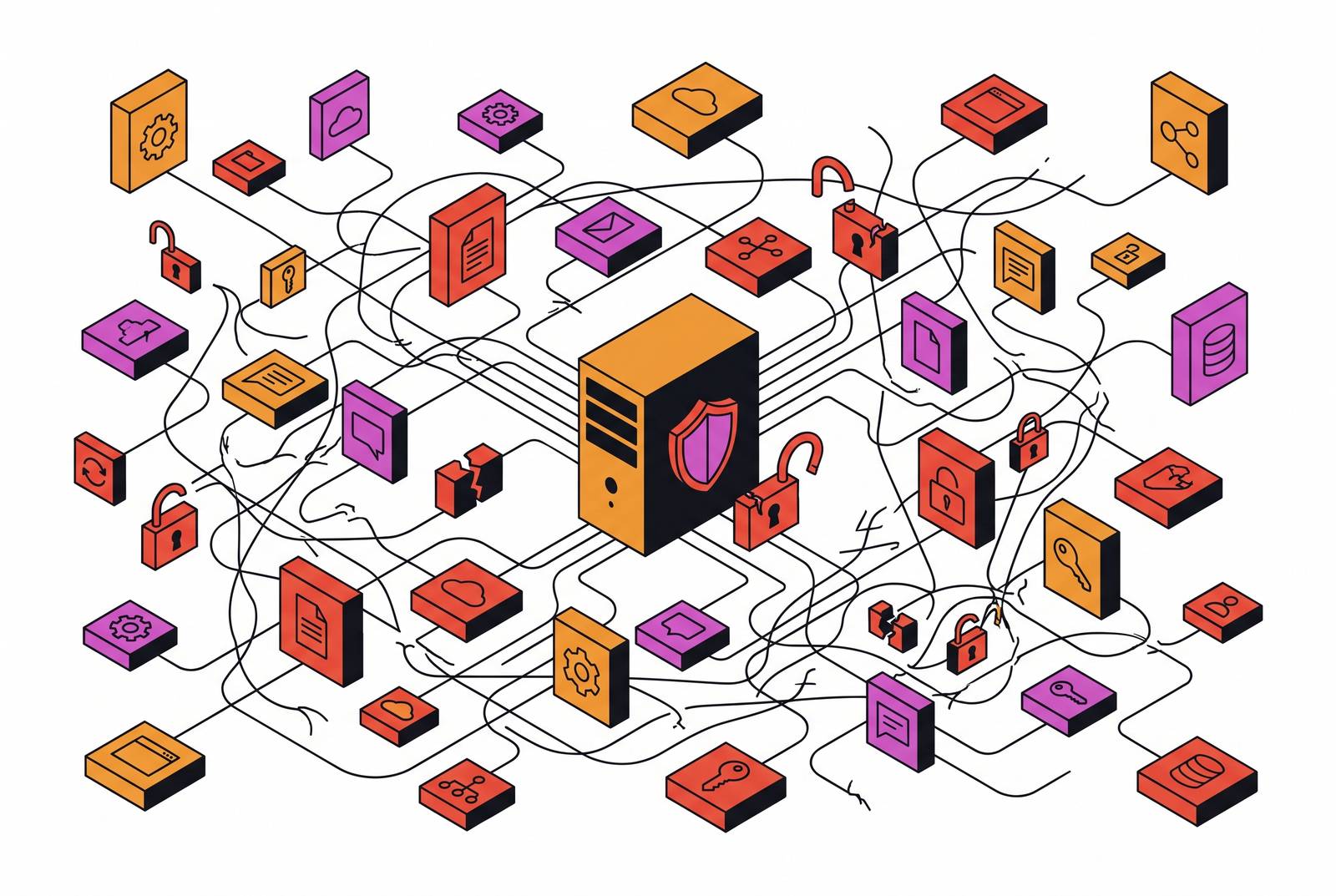
Each of those decisions made sense at the moment it got made. None of them got coordinated with each other. That is the entire mechanism behind vendor sprawl: a sequence of individually rational choices that never add up to a plan. Nobody sat down and decided the business should run on a dozen disconnected vendors. It just happened, one reasonable fix at a time, and the stack that resulted has no single owner and no shared visibility across its parts.
Shadow IT speeds the process up considerably. An employee needs a project management tool, finds one, signs up with a work email and a personal credit card, and starts using it that afternoon. Nobody from IT reviewed it. Nobody from procurement approved it. The tools driving most of this exposure are not obscure or unusual: project management software, file sharing platforms, team communication apps, AI writing assistants, marketing automation tools. Every one of them is legitimate. Every one of them is also capable of holding sensitive business data. That makes every one of them part of the business's attack surface, whether anyone accounted for it or not.
The problem does not end when the employee who signed up for the tool leaves the company. An app registered with a work email but never reported to IT keeps running after that person is gone. The credentials stay valid. The data stays live. No offboarding checklist catches it, because no offboarding checklist knows the app exists.
The security stack itself is not immune to this pattern, it's often a second instance of it. Organizations today commonly run endpoint protection, cloud security, compliance monitoring, and identity management from four different vendors who were never built to talk to each other. The fragmentation that sprawl creates across the business reappears, in miniature, inside the very tools meant to defend it.
Why the gaps between vendors are where attacks happen
The danger in a sprawled environment is not concentrated in any single application. It sits in the space between applications, the space no vendor monitors and no policy covers, because no vendor was ever told that space was part of their job.
Credential proliferation makes this concrete. Every unmanaged SaaS application is its own separate credential set. Passwords get reused across tools. Some are weak. All of them are invisible to IT. Each one represents a possible entry point if it gets harvested through a phishing email or a breach at any one of the services sitting underneath it. A firewall can be configured perfectly and still miss this entirely, because the breach doesn't come through the firewall. It comes through the gap the firewall was never pointed at.
This plays out in a specific, recognizable way when something breaks across a multi-vendor stack. The internet goes down. The business calls the ISP, who says the problem is the router. The router vendor says the problem is the firewall configuration. The firewall vendor turns out to be a separate third party entirely, who needs to be looped in fresh. By the time three support tickets are open, an hour of productivity is gone, the business is still offline, and nobody is contractually responsible for the combined outcome. Each vendor is responsible for their own piece. Nobody is responsible for the seam between the pieces, and the seam is exactly where the outage lived.
Inside the security stack specifically, the same fragmentation produces compounding operational failures. Alerts and policies scatter across systems that share no common language. APIs connecting one tool to another break faster than a lean team can keep fixing them. Analysts spend more time reconciling conflicting data than actually reducing risk. Vendors define basic concepts like zero trust differently from each other, and those definitional gaps turn into blind spots at every boundary between systems.
Managing vendors in silos also means risk assessments happen inconsistently, get duplicated, or get skipped. A vendor can be storing sensitive data without proper encryption, or can quietly fall out of compliance, and nobody finds out until the damage is already done. Compliance exposure expands the same way, silently. Under frameworks like HIPAA, SOC 2, or PCI-DSS, client data sitting in an unknown SaaS application can count as in-scope for audit obligations, even though nobody made a deliberate decision to put it there. A compliance team ends up liable for data it never knew existed.
Why lean organizations absorb this risk differently
Vendor sprawl is a universal pattern, but it does not land evenly. Large organizations have dedicated IT staff, security teams, and formal procurement review built specifically to catch these failures before they turn into incidents. Small businesses usually have none of that, or they have one person covering five jobs at once.
That absence means the work of coordinating between vendors, the phone calls, the tickets, the integration troubleshooting, falls directly on the business itself. None of that work reduces risk. All of it gets borrowed from someone who was never hired to be a security professional.
Alert fatigue makes the problem worse. A single threat alert, on its own, prompts a response. An endless stream of alerts from disconnected tools that don't talk to each other desensitizes whoever is nominally watching them, until warnings stop registering as warnings. A trained SOC analyst can manage that volume as a normal part of the job. An operations manager who also handles HR and payroll cannot, and the result is effectively no security posture at all, even though plenty of alerts are technically being generated.
The stakes scale in the wrong direction, too. Budgets are tighter at a ten-person company. Security staff is smaller, often nonexistent. A single high-risk vendor creates exposure that is outsized relative to the business's size. What reads as a minor housekeeping issue at a thousand-person enterprise is a genuine operational emergency for a ten-person team that cannot absorb a breach, a ransomware payment, or a week of downtime.
Third-party involvement in breaches has grown sharply in recent years, and small and medium-sized businesses carry a disproportionate share of ransomware incidents. More attack surface from sprawl, combined with less capacity to detect or respond to it, does not just change the nature of the exposure. It makes the exposure worse.
Why most businesses skip a vendor inventory
Most small businesses cannot answer a basic question about their own operations: how many vendors do we actually pay for, who owns each relationship, and what data does each one touch? A vendor inventory is the process that forces an answer, and it tends to surprise whoever runs it.
A useful comparison is a post-breach audit at a company in Denver, where investigators went looking for the entry point only after the damage was already done. The full shape of the vendor environment became visible only after the breach, during the audit that followed. An inventory run proactively is the same discovery, minus the breach.
Organizations that run a full inventory across every purchasing channel, not just the tools IT officially approved, commonly find significantly more vendors than expected: sometimes a third to half again as many. The gap between the assumed vendor count and the real one is the sprawl made visible.
Building a real inventory means pulling from several places at once: accounts payable records and expense reports, credit card statements, SSO and identity provider logs, departmental budget owners, and help desk tickets that mention specific tools by name. For each vendor found this way, the minimum useful record includes the vendor name and primary contact, the internal person accountable for the relationship, contract dates and notice periods, annual spend, what data the tool touches, and a rough sense of how critical it is to daily operations.
Assigning a single internal owner to every vendor on that list is the step that keeps sprawl from creeping back in. Without a named owner, tools auto-renew quietly, drift back into shadow use, and recreate the exact risks the inventory was built to eliminate. That owner doesn't need security training. They need to be a specific person who knows what the tool does and answers for it.
Businesses skip this process because it's unglamorous, not out of laziness. Pulling data out of credit card statements, departmental budgets, and SSO logs takes real time and delivers no immediate payoff. In a lean organization, there is rarely anyone whose job description includes doing it, so it tends to wait until something forces the question.
Evaluating risk and redundancy to decide what to cut
An inventory produces a list. The list is not the point. Not every vendor deserves the same level of scrutiny, so the goal is figuring out which ones carry real risk or genuinely overlap with something else already in the stack.
A few factors should drive what gets looked at first. Data sensitivity and access scope matter most: a tool touching customer data, financial systems, or authentication carries more risk than an internal wiki, regardless of how many employees use each one day to day. Security posture is a second factor, and a concrete one. A current SOC 2 attestation or ISO 27001 certification says something real about a vendor's practices. An expired report is a red flag worth acting on immediately, not a paperwork technicality. Business criticality is a third factor: does this tool support a core operation, or is it a peripheral convenience nobody would miss. Usage and overlap round it out. A tool with low adoption that duplicates a feature already covered by something else in the stack is the clearest signal that consolidation belongs on the table.
Dependencies between tools matter here too. Some applications that look minor on the surface are quietly load-bearing, feeding data into or authenticating against systems that matter a great deal more. Mapping those connections before cutting anything separates simple consolidation from complicated consolidation.
One signal deserves immediate action, ahead of everything else on the list: a tool nobody actively uses, that still contains former-employee credentials, and that touches any business data. That combination is an orphaned account at scale, and it is the precise attack path the Denver breach followed. Anything matching that description should move to the top of the queue the day it's found.
Consolidation itself needs a guardrail. The goal is reducing unmanaged complexity, not trading a fragmented stack for a single vendor holding everything with no backup plan if that vendor fails. Cutting tools should shrink risk, not concentrate it somewhere new and unexamined.
What consolidation means in practice for a small business
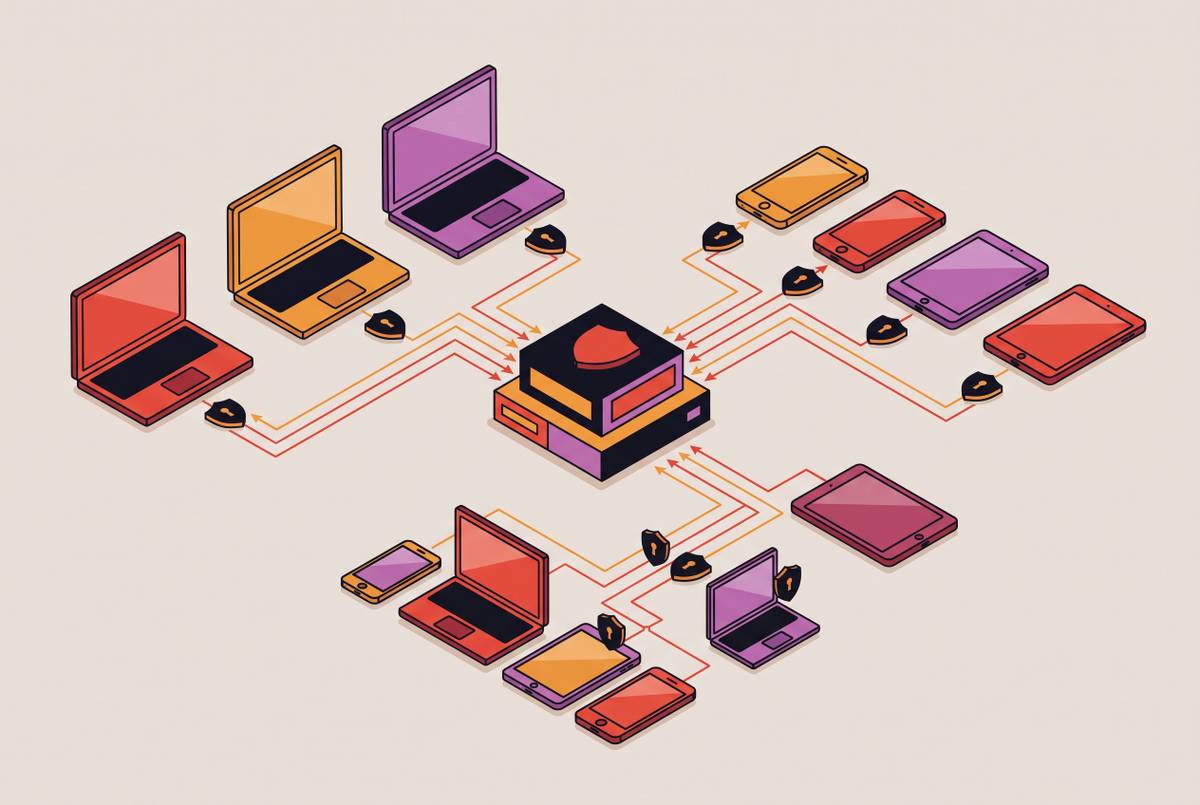
Consolidation replaces a set of uncoordinated point tools with a single integrated system in which device management, endpoint security, identity, and compliance share visibility and enforce policy together.
The accountability gap described earlier is the specific problem this solves. When a single integrated platform owns the environment end to end, there is one place to look when something breaks and one policy layer covering the full surface. The managed services version of this is straightforward: one agreement, one team that already understands the environment, one number to call, instead of three open tickets and an hour lost to vendor finger-pointing.
Identity is where the consolidation priority is highest. Orphaned accounts, reused credentials, and former-employee access paths are direct products of fragmented identity management spread across too many disconnected systems. A unified identity layer closes off the exact class of attack the Denver breach exploited, because there is no longer a forgotten app sitting outside anyone's view holding a live credential.
In operational terms, an integrated stack looks like this: device management and endpoint security run off a single policy engine, so a device that isn't enrolled doesn't get access, without needing a separate tool to enforce that one rule. Identity controls apply across the whole environment rather than just the apps IT happened to provision, so SSO and MFA coverage extends out to the shadow IT the inventory surfaced. Compliance status stays visible on an ongoing basis instead of getting assembled by hand before every audit. Alerts from across the environment land in one place, cutting down the reconciliation work that causes fatigue in a fragmented setup.
For small businesses without a dedicated security team, the practical answer is a platform that covers device management, endpoint security, identity, and compliance in one place, removing the need to coordinate across separate vendors. Zip Security is one example built specifically around that model, aimed at businesses running without an in-house security team, with deployment measured in days rather than months and no configuration expertise required to get it running. The platforms built to handle these domains natively, rather than stitched together after the fact, are the ones that close the blind spots fragmented security stacks tend to create at every boundary.
Centralizing vendor risk visibility changes more than daily operations. It changes what a business can say to an auditor. A single source of truth for vendor data means a direct answer to where sensitive data lives and who has access to it, questions that are effectively unanswerable in a sprawled environment, no matter how good anyone's intentions were along the way.