HIPAA Device Management Requirements for Small Healthcare Businesses
Small practices can close real compliance gaps with encryption, access controls.
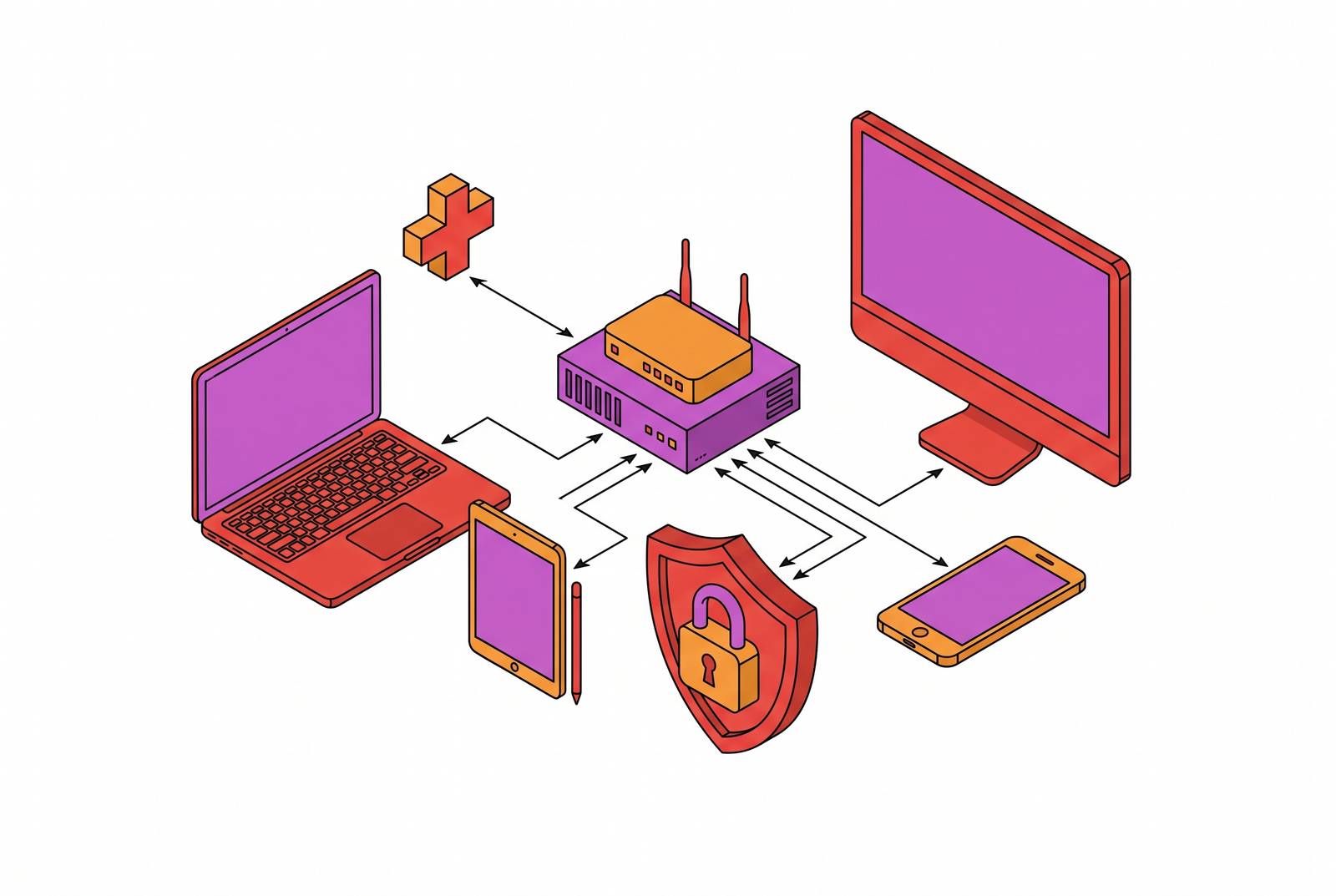
HIPAA's device management requirements give small healthcare practices a concrete, achievable checklist, covering encryption, access controls, audit logging, and remote wipe, that closes real compliance gaps without requiring a security department. Understanding what the current Security Rule demands, versus what the proposed 2026 updates would add, lets lean teams act on the risks that matter now instead of waiting on a rule that is still years from final.
HIPAA's Device Rules and What Has Changed Since 2003
The HIPAA Security Rule was adopted in 2003 and last formally updated in 2013. It was written before cloud computing was common, before telehealth was routine, before ransomware became an organized business model, and before connected medical devices filled exam rooms. Many of its device-related provisions were already showing their age even before the 2026 proposal.
The rule's structure hasn't changed: it still requires administrative, physical, and technical safeguards for electronic protected health information, and device management lives inside the technical safeguards category alongside access controls, audit logging, and transmission security. What has changed is the pressure on that structure. On January 6, 2025, HHS published a Notice of Proposed Rulemaking (NPRM), the first significant proposed overhaul since 2013. The comment period closed March 7, 2025. That proposal amounts to a formal acknowledgment that the current framework no longer matches the risks small practices actually face.
As of mid-2026, OCR has not issued a final rule. OMB's Unified Agenda, under RIN 0945-AA22, now targets July 2027 for final action, a date pushed back from an earlier spring 2026 target. More than 100 hospital and provider groups have asked HHS to withdraw the proposal altogether, which means both the timeline and the ultimate shape of the rule remain unsettled. None of that uncertainty touches the rule already on the books. The current Security Rule is being enforced today, and that enforcement is where small practices carry real exposure, regardless of what happens to the 2026 proposal.
What ePHI covers on a small practice's devices
Device obligations under HIPAA apply wherever electronic protected health information lives or moves, and that turns out to be a much longer list than most small practices assume. PHI includes patient names and addresses, medical record numbers, Social Security numbers, email addresses, appointment schedules, billing information, and insurance information: any individually identifiable health information held or transmitted electronically counts.
In a typical practice with one to ten providers, that information appears in the EHR system and the practice-management platform, in billing systems and whatever integrations connect them to an outside billing service, and in email systems and patient portals, more places than an office manager is likely to list from memory. Telehealth applications carry it during every virtual visit. Imaging systems store it alongside scans. Voicemail systems capture it when a patient leaves a message about symptoms or test results. Copier and printer hard drives retain it longer than most staff realize, since scanned documents often sit cached on the machine itself. Backup media and cloud storage hold full copies of records. USB drives carry it whenever someone exports a file. Personal smartphones and tablets used for work pick it up through email and messaging apps. Even a screenshot of a scheduling screen or an exported report, sitting on a desktop, counts as ePHI the moment it leaves the system it was pulled from.
The compliance surface extends past the practice's own devices, too. The business associate chain means that subcontractors of business associates, such as a cloud backup service used by the practice's IT vendor, fall under HIPAA as well, and the covered entity remains liable for a business associate's violations. That liability makes every vendor relationship a compliance relationship. Any vendor touching ePHI, including the billing service, transcription service, EHR vendor, lab interface, practice management software, and imaging system, needs a current Business Associate Agreement in place. Forgotten or expired BAAs rank among the most common triggers for OCR matters involving small practices. Mapping this surface feels daunting the first time it's done, but it's also the first and most important step toward controlling it. A practice that knows where its ePHI lives is already ahead of most of its peers.
The current Security Rule's device requirements that apply right now
The Security Rule already requires specific, enforceable controls on devices today, and OCR continues to cite their absence in enforcement actions entirely apart from whatever happens with the 2026 proposal. These are the standard a practice is being measured against right now, not future obligations.
Access controls require unique user identification and emergency access procedures, both of which are mandatory, along with automatic logoff and encryption or decryption, which are classified as addressable. Every system that touches ePHI needs to restrict access to people who are authorized to see it. Audit controls require hardware, software, or procedural mechanisms that record and examine activity on systems containing ePHI, meaning actual audit logs rather than a general policy stating that monitoring happens. Integrity controls require mechanisms that keep ePHI from being improperly altered or destroyed. Transmission security requires technical measures that guard ePHI against unauthorized access while it moves across any electronic communications network.
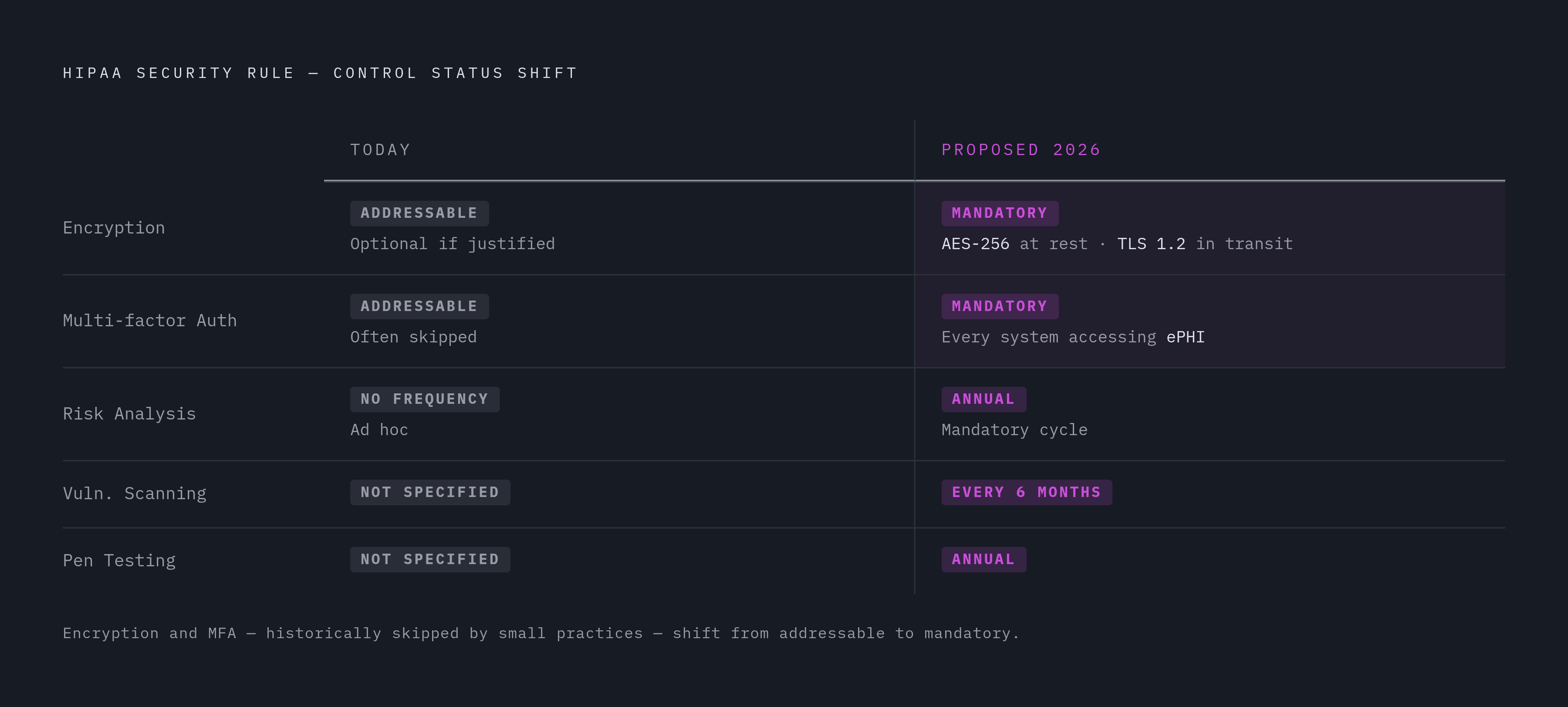
The current rule sorts some of these controls into a category called "addressable," which allows a practice to document why a given control isn't reasonable or appropriate for its setup and substitute something else instead. Encryption of data at rest falls into that addressable category under the current rule. That flexibility is what the 2026 proposal would eliminate, and it shapes how much latitude a practice currently has.
The Security Risk Analysis is required under the current rule, but the rule doesn't specify how often it needs to happen. OCR has long identified risk analysis failures as the single most frequently cited deficiency in its investigations, and that citation occurs even when no breach has occurred. A practice can be out of compliance without ever having been hacked.
Mobile Device Management doesn't appear by name anywhere in the rule's text, but it functions as the practical mechanism that satisfies the technical safeguard requirements, encryption, remote wipe, access control, and audit logging, for smartphones, tablets, and laptops. Physical safeguards round out the picture: workstation use policies, workstation security, and device and media controls covering the receipt, removal, disposal, and reuse of any hardware that touches ePHI are all required under the current rule.
How the proposed 2026 updates would raise the bar for devices
If finalized, the proposed rule would close the addressable loophole and turn controls that small practices have historically treated as optional into firm requirements. None of this is law yet, and the timeline for finalization keeps moving. But the direction of the proposal is specific enough to plan around.
Encryption would become mandatory everywhere ePHI touches a system. AES-256 would be required for data at rest, and TLS 1.2 or higher would be required for data in transit, across servers, databases, laptops, workstations, portable devices, backup media, email, messaging platforms, and cloud storage. Multi-factor authentication would move from addressable to required for every system that accesses ePHI. Practices would need to maintain a written technology asset inventory and a network map showing how ePHI moves through every relevant system, both reviewed at least once every 12 months and again after any material change.
Vulnerability scanning would be required every six months, and penetration testing would be required annually, both on a defined schedule rather than left to each organization's discretion. The Security Risk Analysis would become mandatory on a fixed annual cycle, closing the ambiguity that currently lets practices go years without one. Organizations would need to restore access to ePHI within 72 hours of any disruption. Business Associate Agreements would need to explicitly spell out the new notification and restoration requirements. And the breach notification window for business associates would compress sharply, from the current 60-day standard down to a matter of hours for notifying covered entities.
Nothing here applies today. But every one of these controls already counts as a reasonable security practice under the current rule's risk analysis framework, which makes the proposal a useful planning document even in its unfinished state. Treating it that way costs nothing and buys a practice time it won't have to spend later. Whatever the proposal's final fate, the operational risk driving it hasn't waited for anyone's signature.
Why the threat environment makes waiting for the final rule a poor strategy
Small healthcare practices face active, targeted ransomware risk that turns a device management gap into a practice-ending event. Healthcare is the most attacked industry for data breaches, and ransomware attacks against the sector rose significantly in the first half of 2026 compared to the second half of 2025.
Groups including Qilin, Akira, and Play specifically go after small practices because of leverage, not the size of the potential payout. It's leverage. A solo physician practice can't absorb weeks of downtime the way a large hospital system can, and attackers price their ransom demands around exactly that fact. The majority of ransomware attacks in 2024 and 2025 targeted organizations with fewer than 500 personnel, which describes nearly every independent medical practice in the country.
The exposure doesn't stop at the practice's own front door. Ransomware attacks against the businesses that sit around healthcare practices, billing firms, drug wholesalers, manufacturers, also rose sharply over the same period, so a practice's own business associates can become the entry point for an attack on the practice itself.
Enforcement doesn't wait for a breach either. OCR continues to fine organizations for missing or outdated risk assessments alone, and state-level enforcement is getting sharper by the month. New York's OrthopedicsNY settled for $500,000 with the New York Attorney General in late 2025, and California, Texas, Florida, Georgia, North Carolina, and Pennsylvania have all seen high-profile small-practice settlements in the past 12 months. The regulatory track and the criminal track are converging on the same target, and device controls sit at the exact point where both tracks meet.
The practical device management checklist for a small practice in 2026
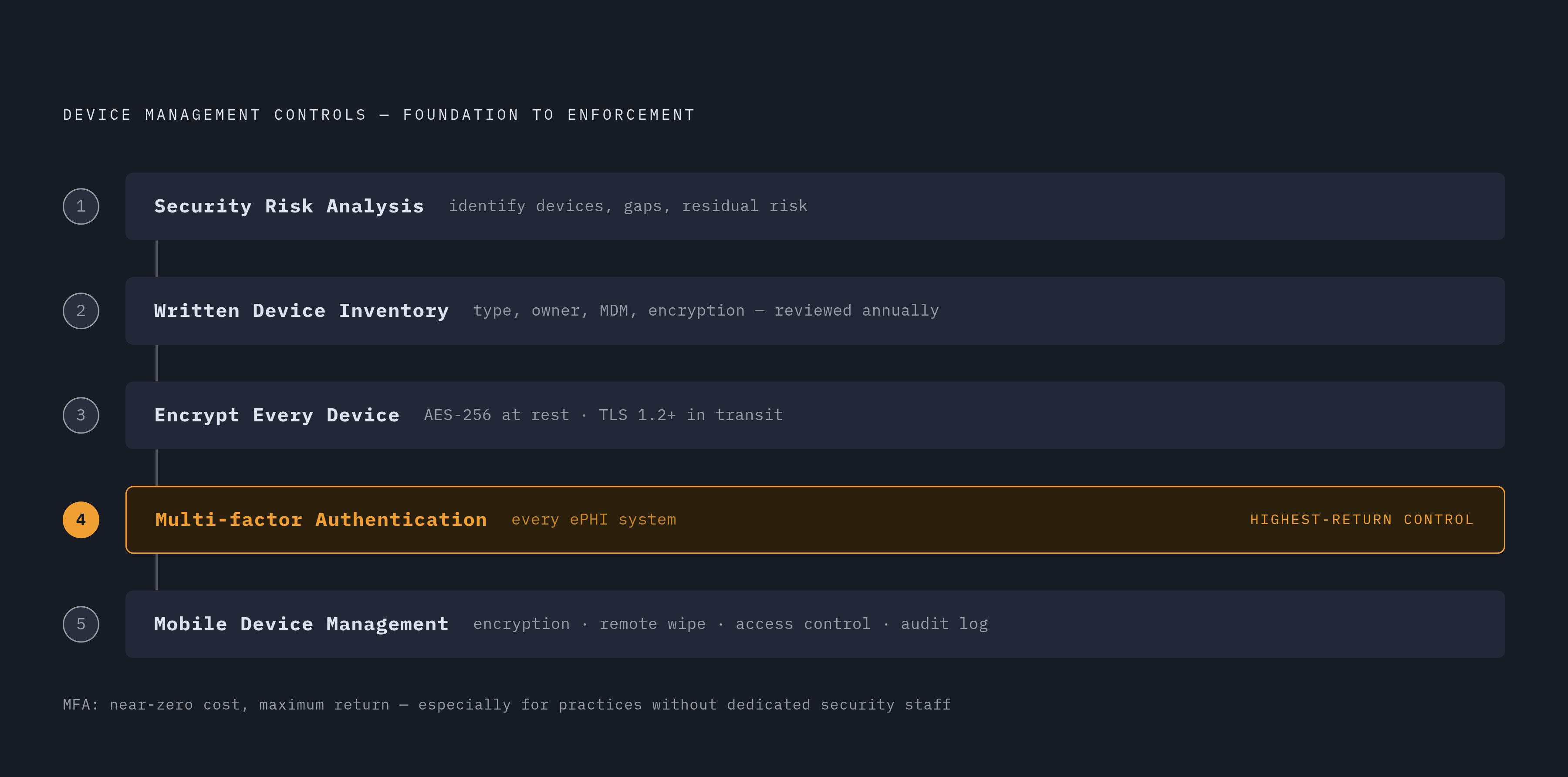
A small practice without a dedicated security officer can meet the current Security Rule's device requirements, and get ahead of the proposed changes at the same time, by working through a short, ordered list of controls aimed at the highest-risk gaps first.
Start with a Security Risk Analysis that covers every device in scope. The SRA is the foundation of the whole effort: it tells the practice which devices hold ePHI, which controls are missing, and what risk remains once existing controls are accounted for. A risk analysis sized correctly for a small practice takes a matter of hours of administrative time when done with a purpose-built tool, instead of the weeks it might take an under-resourced team doing it from scratch. Every decision that follows flows from what the SRA turns up.
Next, build and maintain a written device inventory. Every device that stores or transmits ePHI, workstations, laptops, tablets, smartphones, imaging equipment, backup media, needs to be catalogued, with each entry noting the device type, its owner, whether MDM is enrolled, and its current encryption status. Review and update that inventory at least once a year, and again any time the environment changes materially.
Encrypt every device that touches ePHI. Encryption is still addressable under the current rule, but OCR's practical expectations, shaped by the threat environment, treat it as close to mandatory already, and the proposed rule would make that mandate explicit. The standards to build toward are AES-256 for data at rest and TLS 1.2 or higher for data in transit, the same specifications named in the proposed rule.
Turn on multi-factor authentication for every system that accesses ePHI. MFA is addressable today and would become mandatory under the proposal, but its value isn't about satisfying a checkbox. MFA on email and administrative systems directly reduces credential theft and business email compromise, which rank among the costliest cyber threats practices face in 2026, even though vulnerability exploitation has overtaken them as the most common way attackers get in the door. For a practice with no dedicated security staff, this is the single highest-return control available: it closes the most common failure point at close to zero added cost.
Finish by putting Mobile Device Management in place across every endpoint. MDM is what actually enforces encryption, remote wipe, access control, and audit logging on laptops, tablets, and phones, rather than leaving those controls to manual configuration on each device one at a time. Worked through in this order, the five steps turn a vague, sprawling compliance obligation into a sequence any practice can execute without hiring a security team, and they leave the practice standing on ground the proposed rule, whenever it finally lands, won't pull out from under it.
Sources
- HIPAA Compliance for Device Software: Key Updates 2026
- HIPAA Compliance for Small Medical Practices: 2026 Software Guide
- 2026 HIPAA Security Rule Update: New Requirements to Prepare For
- HIPAA IT Compliance Requirements: A Complete Guide for Small and Medium Businesses
- Federal Register :: HIPAA Security Rule To Strengthen the Cybersecurity of Electronic Protected Health Information
- Summary of the HIPAA Security Rule
- HIPAA Mobile Device Security: Best Practices and Key Steps for 2026
- New HIPAA Regulations in 2026