Cyber Insurance Requirements SMBs Are Failing to Meet
Most small businesses lack the documented security controls insurers now require for coverage.
Cyber insurance requirements for small businesses now demand proof. The substantial share of failed assessments points to the central problem, which is controls that are missing, only partly deployed, or impossible to document. To get insured, a business must close those gaps and show that its protections work. That is also the clearest route to reducing the risk the policy is meant to cover.
Why cyber insurers stopped trusting self-reported questionnaires
A few years ago, a business could answer a short application, check a few boxes, and get a policy. Carriers largely took those answers on trust. Now underwriting includes automated external scans and requests for evidence that controls exist and are correctly configured. Previous experience with an easy renewal is no guide to what the next application will require.
Insurers absorbed massive ransomware losses on businesses with minimal defenses. Reinsurers, the companies that insure insurance companies, demanded higher standards before providing coverage, and that pressure cascaded down to small-business policies. A control that is “mostly enforced” can now flag an application. Even a working control can fail the assessment if the business cannot produce evidence of it.
What the failure rate actually means for a small business without coverage
For a business without coverage, a breach becomes a bill the business has to fund itself. That bill is not limited to fixing a computer or recovering files. Incident response and forensics, ransomware negotiation and ransom payments, business interruption, breach notification, and regulatory fines are costs cyber insurance can cover. When those costs arrive together and demand immediate payment, an uninsured business has no policy to absorb them. The out-of-pocket burden can be enough to close a small operation permanently.
Failing an assessment can also cost money without producing an outright denial. A carrier may still write a policy, but at a significantly higher premium. The business may pay more for coverage while still carrying the weaknesses that made the application difficult.
Closing control gaps costs less than leaving the business to pay for a breach it cannot afford. It also puts the business in a stronger position when coverage and price are decided.
Why small businesses are now the primary ransomware target
Being small does not make a business an unattractive target. Ransomware groups have deliberately moved toward smaller organizations because their defenses are weaker and an operational shutdown creates pressure to pay. Attackers can also reach small businesses at scale through the tools and vendors they depend on. Size is not a shield when the route in is shared.
Recent breach investigation data shows that ransomware is involved in the large majority of small-business breaches, a far higher share than in breaches as a whole. Known unpatched vulnerabilities and stolen credentials provide predictable ways into systems, while ransomware turns access into pressure on the business. Insurers are responding to those same patterns when they demand stronger authentication, patching, endpoint protection, and recoverable backups.
The eight controls insurers now treat as non-negotiable
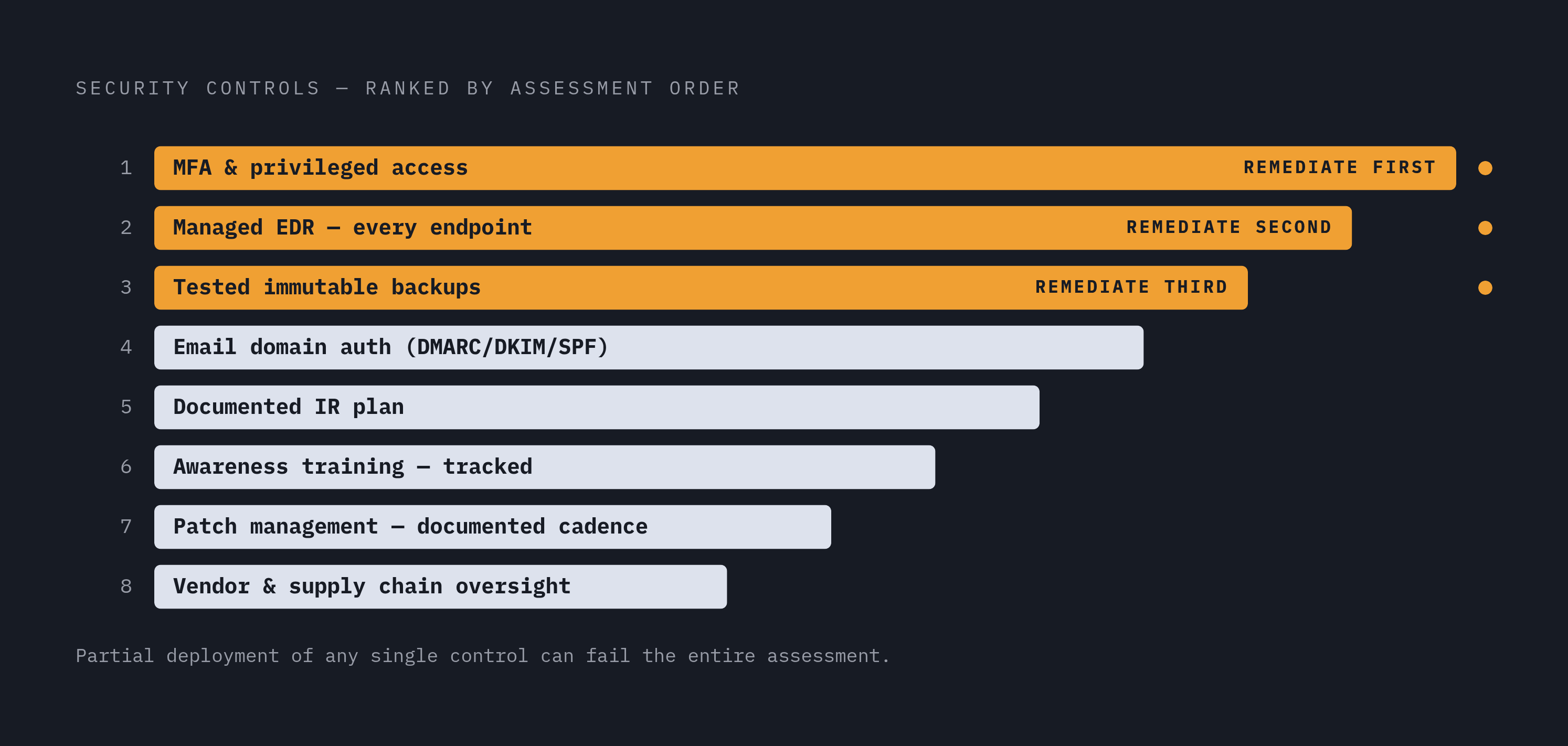
First, identity and privileged access protection. Authentication using more than one factor must cover every interactive account, including those of administrators and executives. That includes every email mailbox, VPN connection, cloud platform, and privileged account. Non-interactive service accounts need compensating controls and records that describe them. Carriers look for enforcement in logs, while privileged access also needs least-privilege rules, separate admin accounts, and records explaining how it is managed.
Second, managed endpoint detection and response. EDR must cover every endpoint, including servers and devices that touch the network. Buying the software is not the same as deploying it everywhere. Coverage is what matters, so an unenrolled device or a lapsed connection can leave the application out of step with what is running. Partial deployment does not meet an all-endpoint requirement.
Third, tested, immutable backups. The requirement is a backup that can support recovery, not simply a backup job that has been configured. Offsite or air-gapped storage belongs in that protection, together with a restore test. The test must have a record showing when it happened, who ran it, and that data was successfully restored.
Fourth, email security with domain authentication. DMARC, DKIM, and SPF records must be correctly configured. These are the domain authentication records carriers can inspect through external scans. A missing or misconfigured DMARC record is an immediate warning sign. Mistakes in the configuration can also break email delivery in the course of everyday work.
Fifth, a documented incident response plan. A downloaded template does not establish who will act when systems are down. The plan needs named individuals, assigned roles, and escalation paths, and it must be stored securely. It also needs testing at least annually.
Sixth, security awareness training with tracked completion. Carriers want a documented training program and periodic phishing simulations. Employees who handle financial or customer data are especially important to that effort. A policy saying training is required does not show that anyone finished it.
Seventh, patch management with a documented cadence. Critical security patches must be applied within a set time after they are released. Automated patching should cover operating systems and software, and records should show that the work was done. The written schedule sets the expectation. Patch history shows whether the business kept to it.
Eighth, vendor and supply chain oversight. Contractors and vendors matter when they connect to business systems or handle sensitive data. Carriers want evidence that the business has evaluated their security posture.
Where the gaps actually are — the specific failures that cause most denials
The common MFA failure is coverage that looks complete from one dashboard but is not complete across the business. Email and the identity provider may require MFA while unsanctioned apps sit outside the policy. New hires may never finish enrollment, and exception lists may grow without expiration dates. Legacy email protocols can bypass MFA entirely. In that situation, “enabled” describes a setting with gaps in enforcement.
A business may have deployed EDR but left a laptop unenrolled or allowed a connection to lapse. The product is present, yet the coverage promised in the application is not. Backups create another version of this problem when a business has configured storage but cannot show a successful restore.
A policy that says “we patch within 14 days” is not a log showing that patches arrived within that window. Without a managed patching tool that produces compliance reports, the business cannot demonstrate the timing it claims. The gap is between the schedule on paper and the history of completed work.
Documentation is also a failure mode in its own right. A business may have offered training without keeping track of who finished it, or it may have an incident response plan with no named roles or dated record of an exercise. In each case, the business has done something useful but cannot substantiate the control the carrier asked about. Screenshots, logs, and policy records distinguish an operating security program from an unsupported answer.
The order in which to close those gaps when you have limited time and budget
Start with MFA everywhere. Extend enforcement beyond email and administrator accounts to every interactive account, VPN connection, and cloud platform. Deal with legacy email protocols that bypass it, and keep records of compensating controls for non-interactive service accounts.
Second, deploy managed EDR on every endpoint. Include employee laptops, servers, and any device that touches the network. This is a control carriers are especially likely to verify, and partial deployment fails the same requirement as no deployment.
Third, establish tested, immutable backups with offsite or air-gapped storage. Run a restore test and document the date, result, and person responsible. Fourth, switch from manual patching to automated patch management that produces compliance reports.
Fifth, configure email domain authentication correctly, including DMARC, DKIM, and SPF. This is a one-time setup carriers can inspect externally, and it directly reduces phishing exposure. Sixth, set up security awareness training and phishing simulations, and keep track of who finishes them.
Seventh, finish the incident response plan by naming the people who will act, giving each a role, and writing down the escalation paths. Run a tabletop exercise and keep the dated record. This is often the last control businesses address, but carriers increasingly want evidence that it has been tested.
If money is genuinely tight, defer a full security information and event management platform, or SIEM, when nobody in-house can read its alerts. At small-business scale, its operating cost can exceed its underwriting benefit. An integrated platform for device management, endpoint security, identity protection, and compliance automation has a more practical documentation advantage. It can bring logs, policy records, patch history, and MFA enrollment reports into one evidence pack instead of leaving them across five disconnected tools.
What the underwriting process actually looks like and how to prepare for it
Treat the assessment as an operational task before renewal. External scans check what can be seen from outside, including email authentication records, software versions, and exposed remote access endpoints. Carriers also check that MFA is enforced and ask for evidence to back that up. An answer on the application cannot cancel out a scan or record showing the opposite.
The evidence request reaches across the security program. It can include screenshots showing MFA enabled on all systems, a written MFA policy for new accounts, and patch compliance logs from a managed tool. Backup test records need dates, and the incident response plan needs named roles. Training completion certificates and evidence of privileged access controls complete the picture of how the business operates.
Timing matters because evidence takes time to accumulate. Implementing controls the week before renewal cannot establish sustained operation. A patch log with two weeks of history does not demonstrate the same maturity as one with six months.
Mature, documented security programs are seeing lower premiums and better coverage terms, while businesses scrambling after denial pay more and get less. Demonstrated maturity also tends to bring smaller renewal increases than bare-minimum controls. But the strongest reason to build that record is not the price of the policy. A program that produces evidence through normal operations is also doing the work of protecting the business. Getting insurable and getting secure are the same project because the controls carriers require address the attacks that put small businesses at risk.
Sources
- Cyber Insurance Security Requirements: What Your Insurer Expects and What to Deploy | Zip Security
- Small Business Cybersecurity Checklist: The Controls That Actually Matter | Zip Security
- MFA for Small Business: How to Deploy Multi-Factor Authentication Across Every Employee | Zip Security
- Identity Access and Device Management: A Simple Model for Modern SMB Security | Zip Security