How Long Security Tool Deployment Actually Takes at SMBs
Vendor timelines assume ideal conditions SMBs rarely have, turning weeks into months.
A security tool bought on a Tuesday rarely protects anything by the following Tuesday, no matter what the sales deck promised. The real driver of delay at small and mid-sized businesses is almost never the technology itself: it's the people, process, and ongoing attention a lean organization has to supply around that technology, and most SMBs don't have the spare capacity to supply it on a vendor's schedule. Vendors build their timelines around a clean environment, a dedicated IT staff member, and documentation that already exists. Few SMBs actually look like that, so the gap between the quoted timeline and the real one opens almost immediately after signature.
A fair planning rule: take whatever number the vendor gives and expect the real one to run longer, sometimes by a wide margin, because a timeline built for an idealized customer meets an organization running security as one task among twenty, which is what happens, not a knock on the sales team. The cost of that gap isn't just a slipped date on a project plan. A tool that's purchased but not yet configured protects almost nothing in the meantime, and the weeks or months it sits half-deployed are exactly the window when a business is most exposed.
The staffing reality that makes every timeline assumption wrong
Most deployments stall for a simple reason: no one at the company has rollout as their actual job. Security tools need someone to configure settings, test them, chase down stakeholders, and keep the project moving day to day. At a lot of SMBs, that person doesn't exist.
Most small and mid-sized businesses have no full-time IT employee. A significant portion lean on an untrained staffer, or on the owner, to handle every piece of technology the business runs on, cybersecurity included. That person is usually running payroll, onboarding new hires, and fixing the office WiFi the same week a vendor expects them to push a new endpoint agent across the entire device fleet. Security deployment loses that scheduling fight almost every time because there are only so many hours in a week, and security was never going to win the queue against a missed paycheck.
The practical effect for buyers: a vendor's quoted timeline assumes a dedicated project owner is sitting on the other end of the deployment. If that person doesn't exist inside the organization, the real timeline stretches, often by months, and that should factor into the decision before a contract gets signed, not after the deployment has already stalled.
Tool sprawl and its cost to deployment timelines
Few SMBs built their security stack on purpose. It usually grows one tool at a time, added after an audit finding, a cyber insurance renewal requirement, or a vendor pitch that solved one specific problem at one specific moment. Over a few years, that adds up to a pile of overlapping products that don't talk to each other, and every new deployment has to find a way to work around them.
That sprawl turns what should be a quick install into weeks of integration work that a clean environment would never need. API tokens sit unapproved in a ticket queue. Data protection agreements have to get renegotiated with each vendor that touches new data. Log formats from one tool don't match what another expects. Consoles step on each other's settings. None of this is a technology failure; it's the accumulated cost of a stack nobody designed end to end.
The administrative load stacks on top of the technical one. Every stakeholder whose system the new tool touches has to be scheduled, briefed, and signed off, and getting an IT lead, a finance approver, and a compliance contact into the same conversation can itself eat weeks at a lean company. The gap between a fast deployment and a slow one often comes down to documentation: an organization that shows up with a current asset inventory and clean records of its existing controls can get the same platform live in weeks, while one that has to build that documentation from scratch during the rollout can take months for the identical product. Having that paperwork ready is what makes a two-week timeline possible instead of a two-month one.
What deployment takes, by tool category
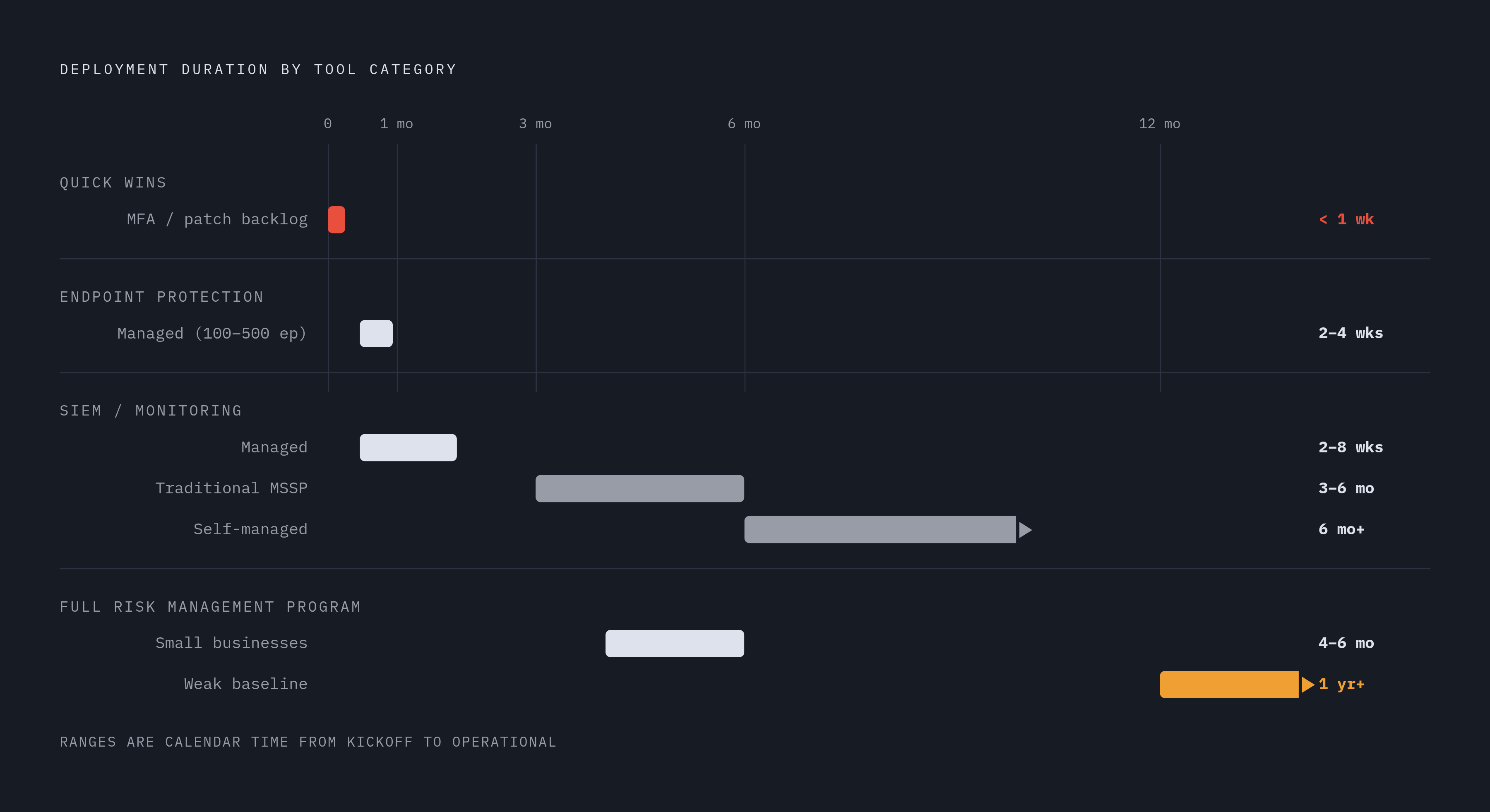
Realistic timelines depend heavily on what's being deployed and whether a managed provider is running it or the organization is managing it alone. Buyers who compare across categories without separating these two variables are setting themselves up to feel blindsided later.
Endpoint protection tools tend to move fastest when a managed provider handles them. For an organization with 100 to 500 endpoints, a managed deployment with integrations already built out typically takes two to four weeks.
SIEM and monitoring tools span a much wider range. A modern, managed SIEM can go live in two to eight weeks. A traditional MSSP engagement, by contrast, often runs three to six months. Self-managed SIEM deployments routinely take longer than the team planned at the outset, usually because the data preparation work, normalizing logs, mapping sources, tuning alerts, gets underestimated from the start.
A full security risk management program is the heaviest lift on this list. Most organizations build one through a multi-month self-managed process. Small businesses should plan for four to six months as a realistic range, and organizations starting from a weak security baseline can spend well over a year reaching a posture that would hold up to a real audit.
Compliance frameworks like ISO 27001 and SOC 2 add their own timeline on top of the tooling, since evidence collection and control documentation take time regardless of how fast the underlying tools go live.
Not everything takes months, though. Some of the highest-value security work can happen in the first week: turning on multi-factor authentication across every account and clearing the backlog of outstanding patches are both tasks a team can finish before the first week is out, and both close off some of the most common attack paths immediately.
These ranges assume the deployment runs the way it's supposed to, with the right people available at the right time. The sections above explain how often that assumption doesn't hold.
The four administrative forces that stall even signed contracts
A signed contract doesn't stop the clock from slipping. Four forces, independent of the technology being deployed, reliably push go-live dates out once a project is underway.
Access provisioning delays come first. Service accounts and API tokens the deployment needs sit in an IT ticket queue while the project waits on something as routine as a password reset or a permissions grant. At an understaffed organization, that single step can cost days or weeks.
Stakeholder scheduling failures come next. Getting an IT lead, a finance contact, and a compliance owner into the same working session sounds simple until those three roles are held by two overworked people whose calendars rarely line up. At a lean company, that scheduling problem alone can set a deployment back by weeks.
Scope creep is the third force. A stakeholder who wasn't part of the original purchasing conversation shows up once deployment starts and adds requirements the project was never scoped to include, expanding the work after the timeline was already locked in.
The fourth force runs in the opposite direction: executive involvement. Deployments with active engagement from leadership move noticeably faster than ones left entirely to middle managers, because a leader can unblock a stuck ticket, resolve a scheduling conflict, or settle a scope dispute in a single conversation. Executive sponsorship functions less like a nice-to-have and more like a scheduling tool in its own right. Organizations without a dedicated security owner face the steepest version of this problem, which is the structural gap that consolidated platforms like Zip Security are built to close: combining device management, endpoint security, identity protection, and compliance into one deployment removes the need to separately staff and coordinate rollouts across several vendors at once.
The rising cost of slow deployment as threats accelerate
A tool that's purchased but not yet fully running offers far less protection than its documentation implies, and the period between signature and go-live is exactly when attackers do their work. Breaches commonly go undetected for days to weeks, and the full lifecycle of a breach, discovery through containment, can stretch to months. A business discovering an incident is often dealing with an attacker who has already been inside for a long stretch of time.
The window attackers have to work with has also gotten shorter on their end, which raises the cost of a slow rollout on the defender's side. AI tools now let threat actors find new vulnerabilities and build working exploit code faster than most organizations can test and apply a patch. The Cloud Security Alliance has described AI as the primary force compressing this timeline, with systems generating working exploit code in as little as 10 to 15 minutes, and Synack's 2026 State of Vulnerabilities Report found that AI-enabled attackers are now exploiting newly disclosed vulnerabilities within hours of public disclosure, compared to weeks as recently as 2022. A deployment delay that was merely inconvenient a few years ago now lands a business in a meaningfully worse position.
Ransomware has changed shape alongside this acceleration. Attacks increasingly involve stealing data before encrypting it, the double extortion model. A solid backup no longer neutralizes the risk on its own. Even a business that could restore every file from backup still faces the exposure of stolen data sitting with an attacker.
The financial stakes land harder on smaller businesses than on large ones. Recovery costs from a breach routinely exceed what a full year of the missed protection would have cost, and a meaningful share of small businesses that get breached report damage severe enough to affect their ability to keep operating. A delayed deployment is an extended stretch of exposure during the exact period when the cost of that exposure has gotten higher.
What separates fast deployments from slow ones in practice
Organizations that deploy on or near schedule share a short list of conditions in place before the project starts, and none of them depend on the vendor.
Documentation is the clearest predictor. A business that arrives with a current asset inventory, a network diagram, and existing control documentation saves real time immediately, and the absence of those three things is one of the most reliable signs that a rollout is about to run long.
A named owner with real authority, someone who can approve access, clear a stuck ticket, or pull three stakeholders into a room, compresses timelines that would otherwise stretch across weeks of back-and-forth scheduling.
Managed deployment models beat self-managed ones by a wide margin across nearly every tool category because a managed provider brings integrations that are already built, a process the team has run many times before, and staff whose only job that week is getting the deployment live.
Platform design plays a direct role too. Tools that run through infrastructure a business already has, rather than demanding a new console, a separate agent, or a parallel set of integrations, remove whole categories of delay before the project even begins. The integration cost that tool sprawl creates, renegotiating a data agreement with each new vendor, resolving console conflicts, reconciling mismatched log formats, is a direct tax on fragmentation, and consolidating onto a single platform cuts down the number of approvals and stakeholders that have to be scheduled.
For a business with no dedicated security team, a single platform covering device management, endpoint security, identity, and compliance means a two-week rollout instead of a year-long project stitching together tools from several different vendors. Zip Security is built for that exact situation: a platform that deploys in two weeks, doesn't require a security expert to configure or run, and is aimed at founders and IT generalists who need a working security program without the job of assembling one piece by piece.
The honest version of planning starts with an accurate read of the organization doing the buying: its real staffing level, the actual complexity of its existing stack, and how much of its documentation already exists versus still needs to be built. Businesses that size that up before signing a contract end up with timelines they can keep, and tools sized for how the business actually runs, not for the idealized customer a sales deck was written for.