Communicating Clearly During a Security Incident: A Playbook for Lean Teams
Pre-plan your incident roles and notification sequence before ransomware forces the choice.
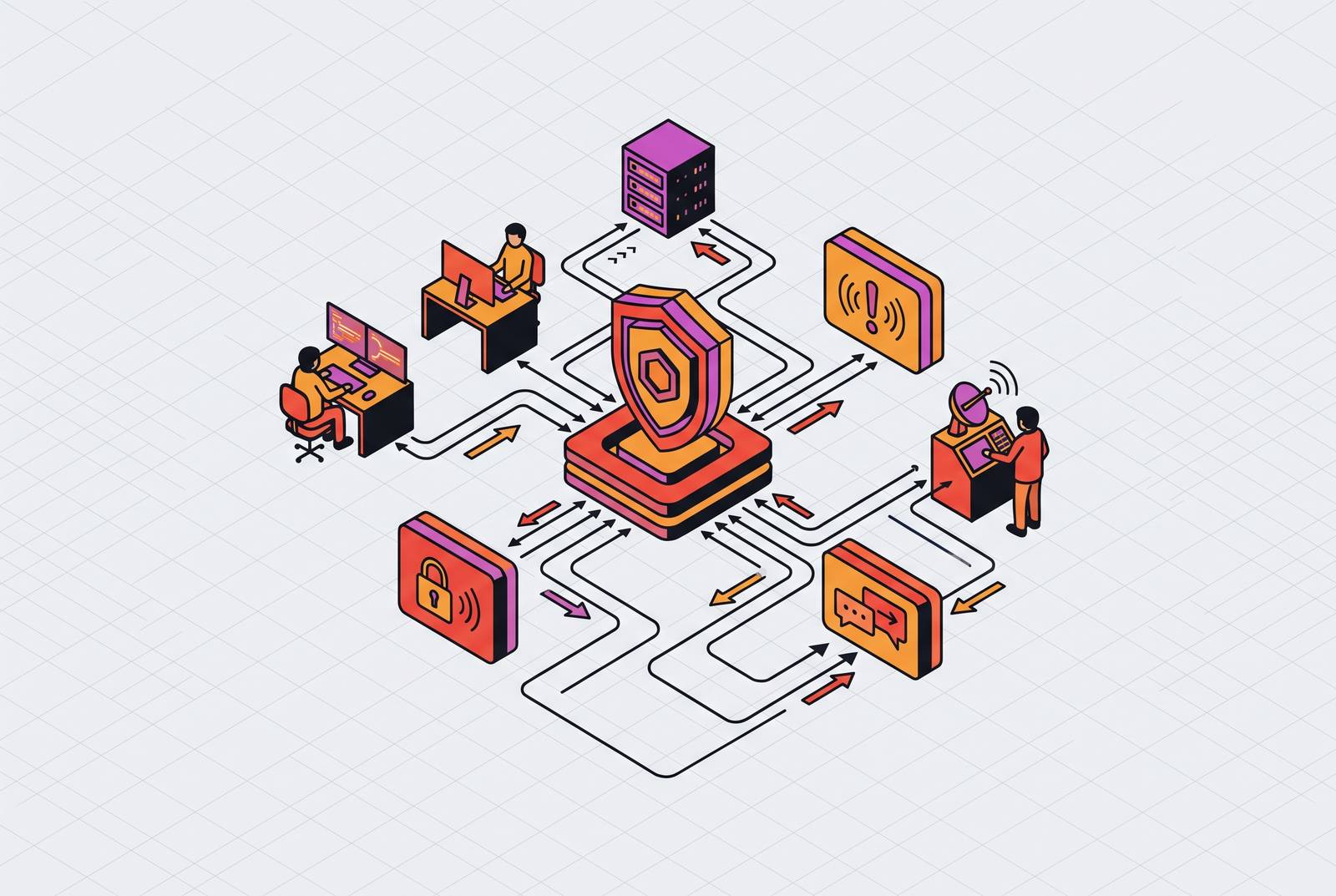
A security incident doesn't fail because of the malware. It fails because nobody knew who to call, what to say, or which channel was still safe to use. What follows is a communication playbook for teams without a dedicated security staff: who gets told, in what order, and with what words, decided before an incident forces the question under duress.
When ransomware hits, the first action is to notify the Incident Commander through an out-of-band channel, meaning a phone call, not email or Slack, since either may already be compromised. The Incident Commander then activates the rest of the response team: the Technical Lead begins containment by isolating affected machines, disabling compromised accounts, and rotating credentials, while the Communications Lead goes on standby drafting from pre-written templates but sending nothing externally yet. Legal counsel and the cyber insurer get looped in before any outside notification is made, because they govern what can be said and to whom. Only after internal roles are active and scope is understood does anything go to customers, regulators, or law enforcement, in that fixed sequence.
The math is blunt. The average breach cost for a small or midsize business hit $140,000 in 2025, and for a team running on thin margins, that number isn't a line item. It's the business.
Ransomware sits at the center of the problem. Sophos found it present in 70% of incident response cases involving small business customers, and 75% of SMBs say they couldn't keep operating after a ransomware hit landed. Phishing runs a close second, accounting for 33.8% of SMB breaches. Keepnet Labs' 2025 research traced 68% of SMB phishing breaches back to one untrained employee clicking one bad link. Business email compromise adds a third front: attacks jumped 48% in May 2025 compared to April, the kind of spike that catches a lean team mid-month with no protocol on hand.
None of this is theoretical. Scattered Spider's April to May 2025 campaign against Marks & Spencer started with a phishing message that tricked IT staff at a third-party vendor into resetting admin credentials. From there, ransomware disrupted e-commerce across more than 1,400 stores, cost the company roughly £300 million in lost revenue, and wiped close to £1 billion off its market value. Strip away the scale, and the mechanism is identical to what a ten-person company faces: social engineering exploiting human behavior, not some exotic zero-day. Orbitalfire's 2025 analysis makes the point directly: attackers don't target revenue size, they target gaps, distraction, and untested plans. The gap is the opportunity.
The four roles every lean team needs to assign before an incident
Communication fails first when roles are assumed instead of written down. A plan with no names attached to it isn't a plan, it's a hope, and hope is not a control.
Four roles need names, titles, mobile numbers, and a backup, decided before anything goes wrong. The Incident Commander is the single decision-maker who triggers escalation, containment, and notification. This person doesn't need to know how a firewall works; they need to know how to make a call under pressure. The Technical Lead handles containment and talks to any outside IT or security vendor, and on a lean team this is often just the IT generalist or the contact at a managed provider. The Communications Lead owns every message that goes out, internal or external, and their job isn't diagnosis, it's translation and filtering. The Legal or Insurance Contact, a pre-identified attorney or carrier representative, matters because some notification decisions carry actual regulatory weight, not just reputational risk.
Of the four, the Communications Lead is the role lean teams get wrong most often, and it's worth saying plainly why: someone assumes that whoever's "good with words" can improvise this live, under pressure, while also fielding panicked calls from three other directions. That assumption is the single most avoidable failure in this entire plan. The Communications Lead has to be the one voice across employees, customers, regulators, and media, and the entire function is preventing contradictory messages from going out at the same time. A short glossary of incident terms, built ahead of time, lets that person turn a technical finding into plain language without twisting its meaning in the process.
Write this role sheet down and keep a copy somewhere offline. Print it, or store it in a repository outside the corporate network, because if the incident locks up the company's systems, a document sitting in SharePoint might as well not exist. Once the roles exist on paper, the next problem is knowing when to activate them.
How to move from "something seems wrong" to "incident declared" without losing 45 minutes
Most lean teams have no defined threshold for this moment. An employee notices something odd, an unfamiliar login, a slow machine, a weird email from the CFO, and has no idea whether to flag IT, call the owner, or shrug it off. That indecision is where critical early time disappears, and early time is usually what decides whether containment happens before or after the damage spreads.
Detection sources need to be documented before they matter, not discovered mid-incident: endpoint protection alerts, employee reports of suspicious emails or behavior, notifications from a managed IT provider, bank fraud alerts (especially relevant for BEC), and any dark web monitoring service already in place.
Severity has to be pre-defined too, or the team ends up escalating based on how scared everyone feels rather than what's actually happening. Critical triggers include confirmed ransomware, active data exfiltration, compromised admin credentials, or fraud in progress. Medium triggers cover a suspicious login from an unfamiliar location, a single phishing click with no confirmed credential theft, or isolated malware on one machine. Low triggers are a blocked phishing email or a failed login with nothing following it. Once severity is assessed, the Incident Commander declares the tier, and that declaration automatically triggers the communication protocol built for it. No debate, no committee, no waiting for consensus that will never arrive in time.
Every indicator should be written for a non-technical employee to recognize. "Your computer started encrypting files you didn't ask it to" works. "Anomalous write operations detected" doesn't, because nobody reports something they can't translate into plain words first. Once the incident is declared, the clock starts on the highest-leverage, most commonly mishandled window of the entire response.
What should a small business do during a ransomware attack, step by step?
Nothing goes external until internal roles are active and someone has a baseline read on scope. Sending a message to customers or regulators before the team understands what actually happened creates legal exposure and reputational damage that often outlasts the incident itself, which is exactly backwards from what most teams instinctively want to do: say something, anything, fast.
The sequence matters, and it runs in a fixed order. First, notify the Incident Commander through the pre-designated out-of-band channel, meaning a phone call, not email or Slack, since either might be compromised. Second, the Incident Commander activates the rest of the response team, reaching each role holder through their documented backup channel. Third, the Technical Lead starts containment in parallel: isolate the affected machine, disable the compromised account, rotate credentials. Containment buys time without destroying the forensic evidence a later investigation will need. Fourth, the Communications Lead goes on standby, drafting from pre-written templates but sending nothing yet. Fifth, the legal or insurance contact gets looped in before any external notification decision gets made.
The out-of-band problem is the piece lean teams skip most often, and it's the one that costs the most when skipped. If the incident involves a compromised email account, ransomware locking down systems, or an attacker with access to internal tools, the normal channels are suspect by definition. A backup channel, a group text thread outside the corporate network, a personal contact list, a printed call tree, needs to exist before it's needed. Incident guidance consistently makes this point: incidents get worse when leaders can't reach a playbook or a decision-maker because the usual channels are down. The fix costs almost nothing. A laminated call tree, kept in a drawer at the office, still works when every screen in the building is dark.
Three things not to do in this window, full stop: don't post "possible breach" in a company-wide Slack before scope is known, don't wipe or reimage affected systems before forensic data is preserved, and don't promise a timeline to customers or regulators that the team can't actually keep. Once containment is underway and internal roles are humming, the harder decision starts: who outside the building gets told, and when.
External notification: who gets told what, in what order, and why the sequence matters
Transparency builds trust. Premature or inaccurate notification destroys it, and can create legal liability on top of the original incident. The sequence exists to manage that tension, not to slow things down for its own sake, and skipping steps in it is the single most common way a lean team turns a contained incident into a lawsuit.
Legal counsel and the cyber insurer come first, before any other outside party, because they shape what can be said and to whom. Only 17% of small businesses carry cyber insurance, which means most lean teams are navigating this tier with no carrier guidance at all, one more argument for getting coverage in place before an incident, not during one. Law enforcement, the FBI or CISA, comes next, and this is a genuinely consequential decision: it changes the shape of the investigation, raises the odds of public attention, and brings tools (search warrants, investigative reach) that a lean team simply doesn't have on its own. Decide the threshold for this call in advance, not in the moment when adrenaline is doing the deciding.
Regulatory notification follows, governed by whatever laws actually apply: GDPR, CCPA, or state breach notification statutes. Legal owns this tier, but the Communications Lead needs to already know which regulations touch the company's data, because that knowledge shapes the language of every message that follows it. Affected customers and partners come after legal has cleared the message and the team understands scope. Notifying people before scope is known does more harm than a short, honest delay ever will. Media comes last, and only if the incident is already public or a regulator requires disclosure. One person handles every media contact. Nobody else on the team speaks on the record, ever, no exceptions for the well-meaning executive who wants to "just clarify something."
A message that holds up says what happened, factually, without guessing at cause or blame. It says what data or systems were touched, what the company is doing right now, what the recipient should do if anything, and when the next update arrives, then it delivers that update on schedule. What breaks trust fastest is speculation, a premature all-clear, or two people from the same company saying different things. One spokesperson, one message, every time. None of this works, though, unless the words are already written before the crisis starts.
Pre-written message templates that hold up under pressure
Good decisions made under stress still produce bad prose. Drafting from scratch during an incident introduces errors, inconsistent tone, and the kind of defensive language that reads as guilt even when there's none behind it.
Five templates should sit ready before anything happens. An initial all-staff notice: "We are investigating a potential security issue. Do not share passwords or access credentials with anyone. Further updates will come from [name] at [channel]. Do not discuss this incident externally." An ongoing internal update covering scope, what's contained, what's still under investigation, and the time of the next update. A customer notification for when data may be affected: factual, cleared by legal, free of speculation, telling the customer what to actually do. A vendor or partner notification confirming whether shared systems are affected and naming a single point of contact. And an executive briefing, one page, covering incident type, current status, containment status, regulatory exposure, and the next decision point.
Every template should follow the same design: fill-in-the-blank structure so the Communications Lead adds facts without rewriting under pressure, plain language pulled from the same glossary built during planning, and a tone that stays calm and factual without slipping into defensiveness or minimizing what happened.
Store these somewhere offline, a printed binder or an out-of-band repository, not solely in the systems the incident might have already touched. Templates and protocols only matter, though, if someone has actually run through them before the real thing happens.
Testing the plan with a tabletop exercise lean teams can actually run
A tested incident response plan saves an estimated $232,000 per breach. And yet a large share of SMBs do not have a tested plan. The gap between those two numbers is the cost of a few hours of a team's time, not the cost of hiring a security department, which is the part that should sting a little.
A tabletop exercise is a guided, discussion-based walk-through of a hypothetical incident. Nobody touches a live system. The point is to test decision-making, role clarity, and communication under conditions that feel almost real, without the actual risk of a real breach sitting behind them.
A format built for a lean team runs two to three hours, using a scenario written in advance: ransomware landing on a Monday morning, a phishing attack that compromised the CEO's email, a vendor exposing shared data. Everyone with a named role in the playbook takes part, and there are no spectators standing off to the side. Mid-exercise, someone introduces new information, "the attacker also got into your billing system," "a journalist just called asking for comment," to force real-time decisions rather than rehearsed ones. Afterward, the debrief documents every gap, every ambiguous call, every assumption that didn't survive contact with the scenario.
These exercises tend to surface the same failure over and over: role ambiguity, two people quietly convinced they own the same decision, discovered only when both of them try to make it at once. That's the failure a laminated call tree and a named Communications Lead exist to prevent. Finding it in a tabletop costs a few hours. Finding it during a real breach costs considerably more, and by then the bill is no longer measured in hours.