Identity and Access Management for Small Business IT
Small businesses face outsized credential risks and need IAM infrastructure to survive.
Small businesses sit at the center of credential-based attacks today, and the reason has nothing to do with carelessness. It comes down to structure: thin IT staffing, limited monitoring, and a patchwork of systems make small firms cheap to breach and slow to notice when they have been. Ransomware is the dominant outcome of SMB breaches, occurring far more often than it does across organizations of all sizes combined. Attackers know small businesses can't run 24-hour monitoring, so a stolen password often goes unnoticed for weeks.
The exposure doesn't stop at the business's own front door. A vendor's weak password policy or an unmonitored contractor account can become the entry point into a business that never clicked a phishing link itself. That's the shape of the modern threat: it rarely needs to break through a firewall. It needs one set of valid credentials, and once it has them, the rest of the intrusion looks like normal activity, because to every system involved, it is normal activity performed by a legitimate login.
That is the core problem identity and access management exists to solve, and it's why the rest of this piece treats IAM as infrastructure a small business needs, not a feature it might get around to later.
What IAM means, stripped of enterprise jargon
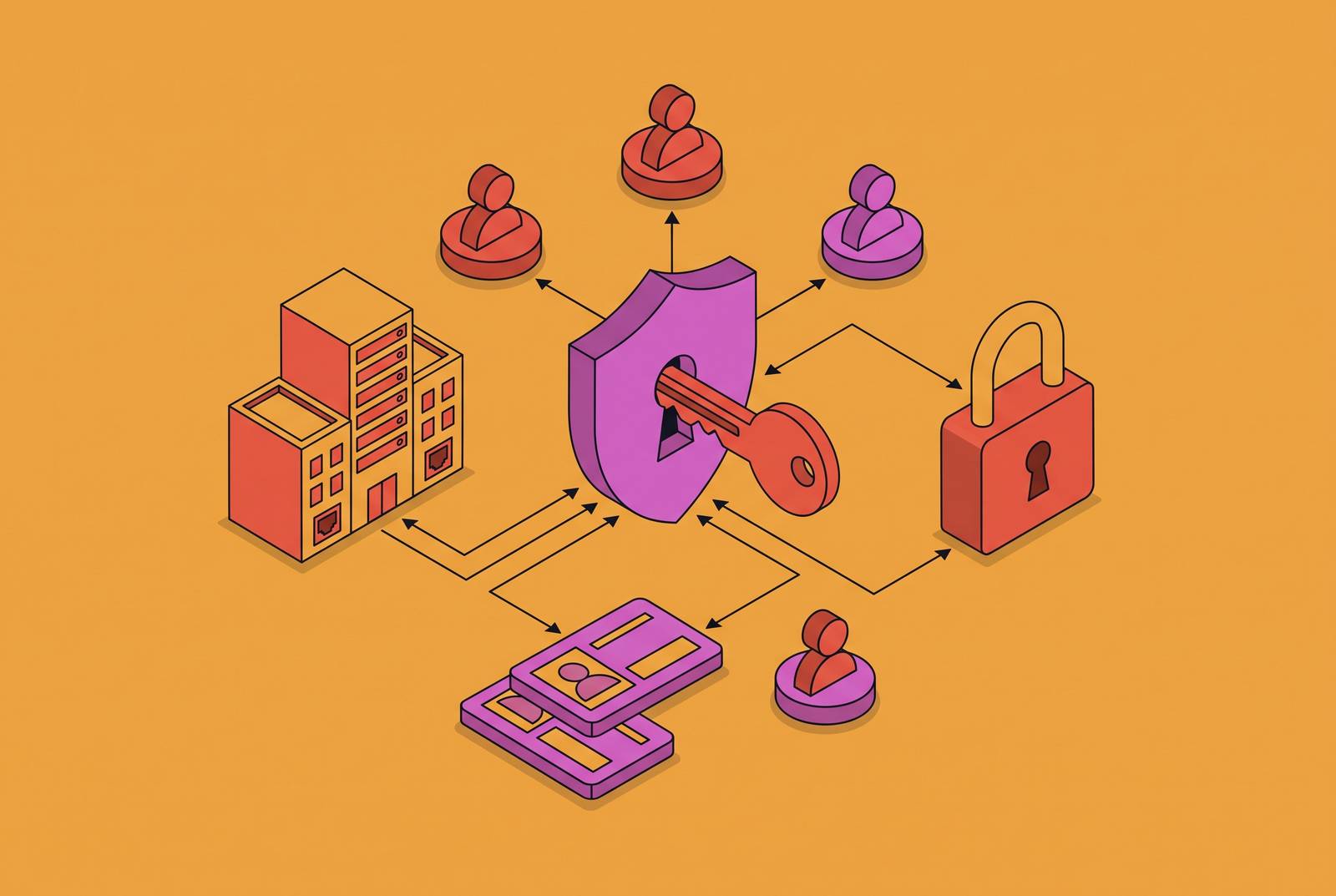
Identity and access management is the set of policies and technology that make sure the right people get access to the right resources at the right time, and that everyone else gets turned away, even if they're holding a valid password. The job is simple to state: control who gets in, control what they can touch once they're in, and remove that access the moment it's no longer needed. IAM governs the full lifecycle of an identity, from the day someone is onboarded to the day their account is shut off.
That framework breaks into four practical disciplines, because each solves a different piece of the problem.
Workforce IAM covers single sign-on, multi-factor authentication, adaptive authentication, directory services, and lifecycle management for employees, contractors, and partners. Small businesses need to start with this layer, because it's where the highest volume of daily logins and the highest volume of daily risk both live.
Identity Governance and Administration, usually shortened to IGA, handles access requests, role management, and periodic access reviews. IGA is what catches orphaned accounts (the login nobody remembered to disable) and over-privileged users (the employee who still has access to a system from a role they left two years ago).
Privileged Access Management, or PAM, covers credential vaulting, just-in-time access, and session recording for admin-level accounts. These are the accounts attackers go after first, because a single admin credential often unlocks far more than a standard user account ever could.
Machine and AI identity security governs service accounts, API keys, and AI agents. This is the newest and fastest-growing risk category, and most small organizations haven't addressed it. Non-human identities now outnumber human identities in most environments, and they often hold broad privileges with no owner actively watching them. That combination makes them a favorite target.
By 2026, a fully modern IAM setup includes biometrics, adaptive authentication, AI-based anomaly detection, privileged access controls, and real-time visibility into SaaS applications. A small business doesn't need all of that running on day one. What matters is understanding the four disciplines above and knowing which one to build first.
Zero trust is a term worth defining, because it gets thrown around as if it were a product. Zero trust is an operating principle stating that no user and no device is trusted by default, regardless of whether they're inside the network or outside it. IAM is what makes that principle enforceable in practice, through single sign-on, MFA, role-based access control, and privileged access management working together.
Which IAM controls matter for a business running lean
The list of IAM disciplines above can look like a lot to take on with no dedicated security staff, but it isn't. A short set of controls, implemented well, closes most of the credential-attack surface a small business actually faces. The goal is depth on the handful of controls that matter most, not running every tool in the IAM catalog.
Multi-factor authentication is the single highest-leverage control available, and the order of rollout matters. Start with email, because a compromised inbox is the password-reset path into nearly every other system a business runs. Each stage closes a door that attackers are actively testing.
Not all MFA holds up equally well anymore. For high-risk accounts, phishing-resistant FIDO2 passkeys are the stronger option, because they can't be phished the way a six-digit code can.
Single sign-on does more than save employees from juggling a dozen logins. It centralizes authentication, so a single policy change applies everywhere at once, and it turns deprovisioning into one action instead of a manual checklist across every app an employee ever touched. A departing employee with lingering access to five SaaS tools is five separate risks sitting unattended.
Adaptive or conditional access, meaning authentication requirements that adjust based on location, device, and behavior, adds a detection layer on top of static MFA. This is increasingly built directly into workforce identity platforms, so it's no longer an enterprise-only feature.
None of this requires a full zero trust product rollout, and businesses under roughly 200 users don't need one. The controls above, properly implemented, deliver most of what zero trust means in practice, without the overhead of standing up a dedicated zero trust architecture.
AI-driven attacks and the IAM tools that stop them
AI has made credential attacks faster, more convincing, and harder to catch with the static controls that were sufficient five years ago. Attackers now use AI to automate credential stuffing at scale, generate phishing emails personalized to a specific target, and run deepfake voice and video calls convincing enough to bypass SMS-based MFA.
The tactics are also getting more patient. In January 2026, researchers uncovered an attack in which hijackers compromised a contractor's email account to infiltrate a live C-suite approval thread already in progress. That's a social engineering technique aimed at business trust itself, not at any software vulnerability. The thread looked legitimate because, until the moment of compromise, it was.
The ShinyHunters attack pattern shows how a credential breach compounds once it's inside. The cycle repeats because IAM governance wasn't tight enough to catch the intrusion the first time.
Volume alone adds to the pressure. AI-generated malicious emails have roughly doubled in a short period, and that increase is a real risk multiplier for a small firm with no SOC to triage the flood. Add to that a quieter risk: employees accessing generative AI tools on corporate devices through personal accounts, creating data leakage paths that most small businesses have no policy or technical control to catch.
The same AI driving these attacks is also improving the defenses built to stop them. Adaptive MFA, adjusting requirements based on location, device, and behavioral signals, is the practical answer to static MFA getting bypassed. It raises the cost of a credential attack substantially, without adding friction to a legitimate employee logging in from their usual laptop and location.
What to look for in an IAM platform without a security team
For a lean team, the right IAM platform enforces strong controls without needing a trained security operator to configure, monitor, and maintain it every day. Operational simplicity is a security requirement here, because a control nobody can maintain is a control that quietly stops working.
A few evaluation criteria matter most, in this order. And non-human identity coverage, meaning service accounts, API keys, and AI agents, should be discoverable and governed under the same policies as human accounts.
Platforms built around enterprise security teams, with complex configuration screens, dedicated admin consoles, and dashboards full of alerts, tend to dump operational burden onto whoever happens to own IT at a small business. An integrated platform that handles device management, identity protection, and compliance automation in one place fits a lean team far better than stitching together separate point solutions, each with its own vendor relationship and its own configuration to learn.
With those criteria established, the next question is how specific platforms on the market actually measure up.
Comparing Leading IAM Platforms for Small Business
Most of the platforms that dominate IAM today were built for enterprise security teams with staff dedicated to running them. Knowing where each one fits helps a small business avoid buying a tool built for a problem it doesn't have.
Microsoft Entra ID is a strong fit for organizations already running Microsoft 365 and Azure. It covers SSO, MFA, Conditional Access, hybrid identity, and Privileged Identity Management. Non-Microsoft app coverage and non-human identity governance often need a complementary tool alongside it.
Okta Workforce Identity Cloud is a cloud-native platform built for SSO, adaptive MFA, lifecycle management, identity governance, and secure access across cloud, on-premises, and hybrid environments. Its integration network runs deep, making it a strong choice for SaaS-heavy businesses, and its lifecycle management automates the joiner-mover-leaver process well. It suits organizations with a diverse application environment and at least some IT capacity to manage it.
Delinea leads with privileged access management: credential vaulting, just-in-time access, and unified access controls across servers, applications, cloud environments, and vaults, with continuous discovery of human, machine, and AI identities.
CyberArk, now part of Palo Alto Networks, provides centralized protection for high-risk accounts and credentials, developer-focused secrets management, and compliance-ready audit trails. It's enterprise-grade in capability and in operational complexity alike.
Saviynt leads with identity governance: role mining, entitlement visibility, access certifications, and segregation-of-duties enforcement. It's cloud-native and strong in regulated industries, but its governance depth assumes an organization complex enough to need that level of control.
SentinelOne Singularity Identity offers proactive defense for Active Directory and Entra ID, with real-time detection and response for identity-based attacks and deception tactics aimed at adversaries already inside the network. It suits organizations with an existing endpoint security investment in the SentinelOne platform.
LastPass Business positions itself as a fast path to enterprise-grade IAM without enterprise complexity. It covers password management, SSO for up to 3 apps, and basic MFA, with advanced SSO and MFA reserved for the Business Max tier. It's a reasonable starting point for a small business with a low IAM baseline today, though its scope is narrower than a full workforce identity platform.
Zip is built specifically for small and mid-sized businesses without a dedicated security team. It integrates device management, endpoint security, identity protection, compliance, email security, and data loss prevention into one platform, and deploys in two weeks. Of the platforms covered here, Zip is the one built from the ground up for the lean-team context most small businesses are actually operating in.
The IAM controls cyber insurers now require
Cyber insurance has turned into something close to a de facto IAM audit. Insurers are voiding claims when they discover that the controls a business attested to on its application weren't actually in place at the time of the breach.
The failure mode is specific: insurers deny claims when controls were attested to but never deployed, or when they were only partially deployed, MFA enabled on some accounts but not all. The policy turns out to be void at the exact moment the business needs it most.
The audit trail an IAM platform produces, access logs, provisioning records, MFA enforcement reports, is the evidence insurers require to validate what a business claimed on its application. A platform that can't generate that evidence creates a compliance gap even if the underlying controls are technically running day to day.
This dynamic turns IAM from a discretionary security decision into a financial and legal obligation. A small business that can't absorb a $100,000 breach certainly can't absorb paying one out of pocket because its coverage was voided over an attestation it couldn't back up. The platform chosen has to produce that evidence on demand, not just enforce the controls quietly in the background.
Implementing IAM foundations without a dedicated security team
None of this requires a phased, multi-quarter enterprise rollout. A small business can reach a defensible IAM baseline in weeks by sequencing the right controls in the right order, on a platform that doesn't demand a trained operator to run it.
Start with an identity inventory. List every account in the environment: employee, contractor, service account, API key. Nothing can be governed if it hasn't been found first, and orphaned accounts and over-privileged users are almost always uncovered right here, in the first pass.
Deploy MFA on email first, then on admin accounts, then across everything else. There's no reason to wait until MFA is everywhere before turning it on somewhere. Every account protected immediately shrinks the attack surface by that much.
Enforce SSO across the application portfolio. A single login point means a single place to enforce policy and a single action to revoke access when someone leaves.
Put a joiner-mover-leaver process in writing, even a simple one.
Some tools can wait. SIEM and SOAR platforms need trained staff to produce any real value, and managed EDR with SOC monitoring included covers the high-value use cases at a fraction of the operational load for a lean team. An integrated platform that handles device management, identity, and compliance together removes the coordination burden of running those as separate tools, and it gets a business to a working baseline faster than assembling the equivalent out of point solutions one at a time.
None of this demands a security team. It demands the right platform, the right sequence, and the discipline to start this week.