Retainer-Based IR vs Break-Fix Engagements for MSPs
Retainers respond in minutes; break-fix takes hours attackers don't give you.

A retainer buys a response team before an attacker gets in. Break-fix buys a phone call after the damage is already spreading, with no guarantee anyone answers fast enough to matter. For a small business with no security staff, that difference matters far beyond preference. It's the entire ballgame.
Why the gap between the two models widens to dangerous proportions under real attack conditions
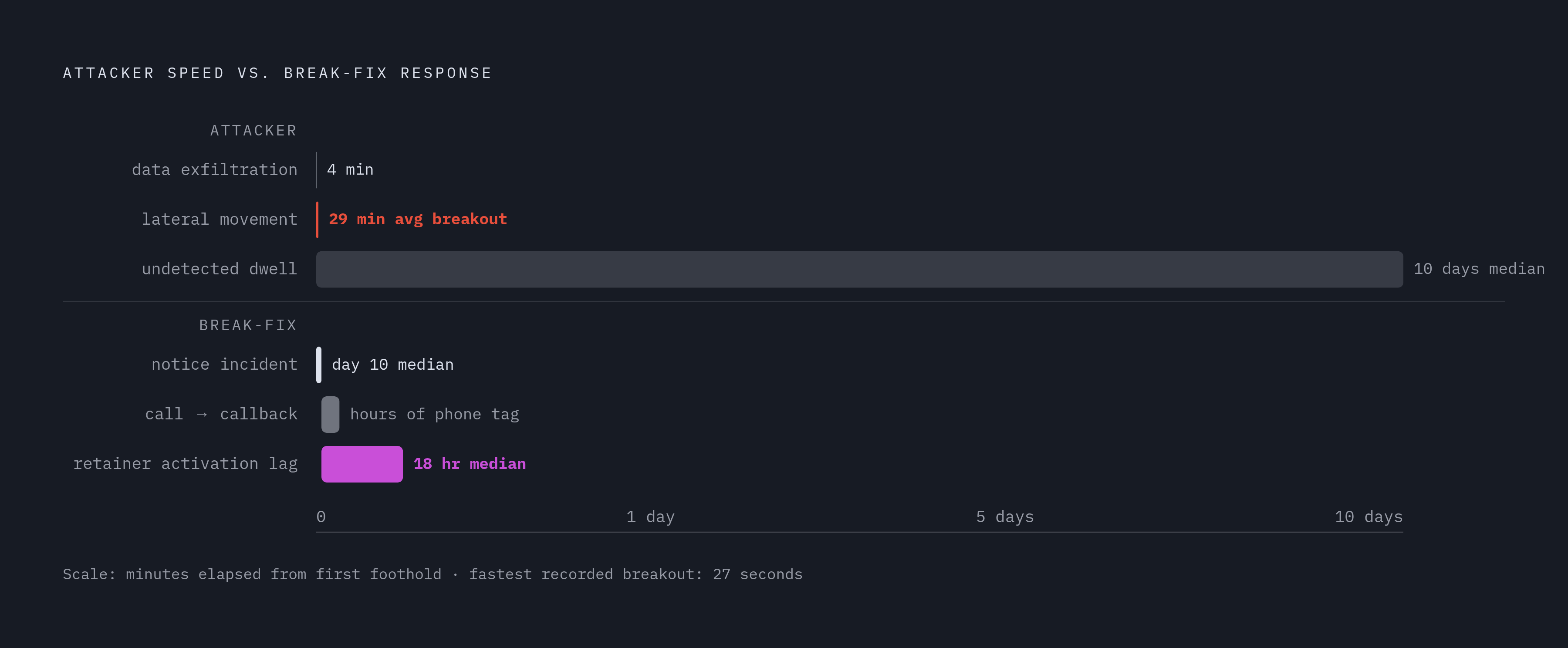
Speed is the whole story now. CrowdStrike's 2026 Global Threat Report puts the average eCrime breakout time (the span between initial access and an attacker moving laterally into the rest of the network) at 29 minutes in 2025, a 65% jump in speed from the year before. The fastest breakout CrowdStrike recorded: 27 seconds. In one documented case from that same report, data was already leaving the network within 4 minutes of the first foothold.
Run that math against a break-fix client. Someone notices something's wrong, starts calling vendors, waits for a callback, negotiates a rate, signs paperwork, and only then does an analyst start looking at logs. None of that happens in under 29 minutes. By the time a responder is even on the phone, the attacker has probably already moved past the entry point and into whatever they came for.
Mandiant's M-Trends 2024 report found a global median dwell time (the stretch between an attacker getting in and someone finally noticing) of 10 days. Ten days is the window attackers get to expand their foothold, pull data out, and plant backdoors for later. For a break-fix client, all 10 of those days pass with no one pre-positioned to respond. Every hour is an hour with no containment plan running in the background.
Even paying for a retainer doesn't guarantee it works the way you'd expect under pressure. Data from the decryptiondigest.com buyers guide shows the median time for an IR engagement to actually activate after discovery sits at 18 hours, and 32% of organizations find gaps in their retainer coverage only once an incident is already underway. That 32% figure is worth sitting with: these are companies that did the right thing and bought a retainer, and it still let them down because nobody read the contract closely enough. Break-fix clients don't get to discover a gap. Nothing was there to check.
A handful of contract terms decide whether a retainer holds up when it counts:
- SLA clock definition. The service-level agreement needs to start ticking at first contact with a qualified analyst, not when a case gets opened in some ticketing system, and not when an analyst gets assigned three hours later.
- Surge billing and time increments. Surge rates commonly run 50 to 150% above the base retainer rate, and many firms bill in minimum blocks of four hours. A call shorter than that threshold can still get billed as four hours without anyone reading the fine print first.
- Screening timeline. A regulatory screening process (checking whether a ransomware group is on a government restricted-entity list) requires time to complete. Treasury blocklist) can take under two hours if it's handled in-house. Route it through a separate legal team instead, and that can stretch to 24 or 48 hours, which is disastrous when a ransom deadline is running.
- Rollover policy, disclosure limits, and data handling. Unused hours that just expire are money wasted, and worse, they create a weird incentive to use the service even when it's not needed. Some contracts restrict what a client can say publicly about a breach, which can collide with mandatory notification laws. And forensic images or log files handed to the IR firm need a clear answer on where that data lives, how long it's kept, and whether it feeds into the firm's own threat intelligence products.
This paperwork serves a purpose beyond itself. Every one of those terms determines whether the retainer functions in the first hour of a live breach, or just looks good sitting in a drawer.
The threat environment that makes this choice consequential for small businesses specifically
Small businesses aren't a side note in the ransomware story. They're the main character. One industry report, drawing on 22,052 security incidents and 12,195 confirmed breaches, found ransomware present in 88% of SMB breach incidents, against 39% at large organizations. Verizon's data also shows SMBs suffered roughly four times as many confirmed breaches as large organizations in 2024.
The reasoning behind why attackers pick smaller targets isn't complicated: less protection, weaker backup systems, thinner network segmentation, fewer endpoint defenses. Attackers go where the resistance is lowest, and smaller firms are, on average, exactly that. Smaller organizations face recovery costs per employee that can far exceed what larger enterprises absorb, which tells you something about how badly a small operation can be knocked off balance by one incident.
Hiring your way out of this isn't realistic for most small firms either. ISC2's 2024 Cybersecurity Workforce Study put the global shortfall of cybersecurity workers at 4.8 million people. There simply aren't enough qualified analysts to go around, and a five-person IT department isn't going to out-recruit a bank for the ones who exist.
What happens when an attack actually lands: 37% of SMBs hit in 2025 lost more than $500,000 in a single incident, and ransom payments alone can consume a significant share of a small firm's annual IT budget. Downtime costs from lost productivity and recovery work typically dwarf the ransom payment itself. And 38% of attacked SMBs raised prices afterward just to cover the losses, meaning the fallout reaches customers too, not just the balance sheet.
The volume keeps climbing. Ransomware attacks rose 45% in 2025, with 9,251 recorded attacks compared to 6,395 the year before, and ransomware factored into 44% of all data breaches in 2025, up from 32% the year prior. Put those numbers next to the workforce shortage and the recovery-cost data, and a blunt fact emerges: the organization most likely to get hit by ransomware is also the organization least likely to have anyone pre-positioned to respond. The gap between a retainer and break-fix is widest exactly where the stakes are highest.
What the financial case for a retainer actually looks like when you run the numbers
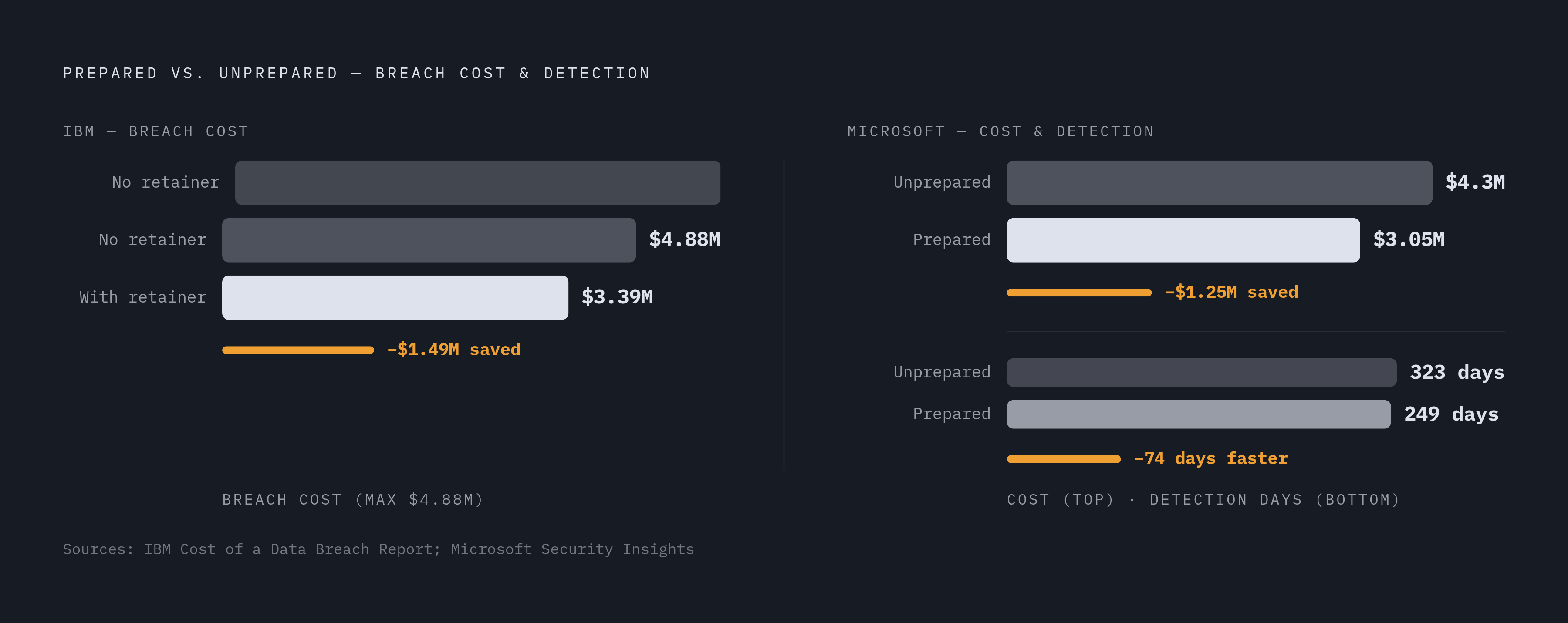
IBM's Cost of a Data Breach report put the average cost of a breach at $4.88 million, and found that organizations with an IR retainer already in place cut that figure by $1.49 million. The saving is not marginal. That's the difference between a bad year and a company-ending one.
Microsoft's Incident Response data tells a similar story from a different angle. Companies caught unprepared faced an average breach cost of $4.3 million globally. Companies with IR support and automated tooling in place averaged $3.05 million, a meaningfully lower figure. Those same prepared organizations also caught breaches 74 days faster, 249 days on average versus 323 days for the unprepared group. Nearly two and a half months matters when an attacker is sitting inside the network the whole time.
Weigh the cost of a retainer, a block of pre-purchased hours at a discounted rate, against a $1.49 million average reduction in breach cost, and the math stops being close. A retainer doesn't need to prevent a single breach to justify its price. It just needs to shrink the damage of the breaches that happen anyway.
Break-fix carries the opposite risk profile: no ceiling on hourly billing once a crisis is underway, emergency surcharges layered on top, and surge rates at 50 to 150% above whatever the "standard" number was supposed to be, because there was no standard number locked in beforehand. There's also a cost the spreadsheets don't capture cleanly: a break-fix provider starts cold. It doesn't know the network architecture, doesn't know which servers matter most, doesn't have a contact list. All of that has to get built during the incident itself, and every hour spent building it is an hour billed and an hour the attacker keeps operating.
Insurance and compliance add another layer. Cyber insurers increasingly ask, before underwriting a policy, whether a retained IR provider is already under contract. Frameworks like SOC 2 and ISO 27001 treat incident response readiness as a core requirement, not a nice-to-have, and a signed retainer is documented proof of that capability sitting on file. It's the kind of thing that shows up favorably in a vendor questionnaire or a board risk review. A break-fix arrangement has nothing to point to, because there's no agreement to point to until the crisis is already happening.
How IR retainer firms are structured and what tier of provider fits a lean organization
Retainer providers generally split into three tiers, and picking the wrong one is its own kind of expensive mistake.
Big consulting firms with deep forensic practices offer the broadest investigative depth, strong regulatory expertise, and coverage that spans the globe. That's the right fit for an organization staring down a serious regulatory breach scenario, healthcare data, financial services compliance, that kind of exposure. What they don't offer, for most incidents, is meaningfully faster response than a specialist firm charges less for.
Specialist IR firms sit in the middle: mid-tier pricing, strong forensic chops, and often quicker activation than the large consulting shops for standard cases like ransomware and data exfiltration. For most small and midsize businesses, this tier fits the actual risk profile better than either end of the spectrum.
MDR providers that bundle in IR sit at the lowest cost of entry. They work well for organizations that need ongoing monitoring plus a baseline IR capability, but they can come up short on forensic depth if a complex regulatory incident lands on the desk.
The common misstep is picking the wrong tier in either direction: overpaying for top-tier forensic depth that isn't operationally faster for a routine ransomware case, or buying MDR-with-IR coverage that can't support the forensic rigor a regulator will eventually ask for.
Microsoft's Incident Response Retainer, now sold as Cybersecurity Incident Response under Unified customer contracts as of January 1, 2024, is worth knowing as a reference point. It uses pre-paid hours applicable to incident response work, operates across 190 countries and doesn't require the client to run Microsoft's own security stack.
Whatever tier gets chosen, the same evaluation checklist applies: a clearly defined response SLA (with the clock-start language spelled out), geographic coverage that matches where operations actually sit, cloud forensics capability if any meaningful share of infrastructure lives off-premises, coordination ability with law enforcement and cyber insurers, and a documented OFAC screening process with a real timeline attached.
On pricing, SMB-focused MDR services vary widely in price depending on how much active response is bundled in. Treat any vendor quotes as a planning benchmark, not a hard ceiling. One thing worth watching for: some providers price by log volume instead of by endpoint or user, which means the bill spikes right when the client is under attack and generating the most data. Flat, predictable per-endpoint pricing is the friendlier structure for a budget that can't absorb surprises.
What lean organizations without a dedicated security team should actually weigh when deciding
The real question is which model delivers more value. It's whether the business wants a response capability built before a crisis starts, or a vendor it's hoping will pick up the phone once one is already underway.
Break-fix holds up as a defensible choice in a narrow set of cases: a genuinely small digital footprint with no sensitive customer data, no regulated information, and no cloud infrastructure of real consequence, paired with prevention layers already strong enough to meaningfully lower the odds of an incident in the first place. That's a small slice of businesses.
A retainer is the right first move for almost everyone else. Any organization holding customer records, financial data, or health information falls into that group. So does any business facing SOC 2, HIPAA, CMMC, PCI, or NIS2 obligations, any business carrying or applying for cyber insurance, and any business that's already lived through one security incident and knows what the scramble feels like.
Microsoft's Incident Response data found only 41% of CEOs believe their organization is actually prepared for a cybersecurity crisis. A retainer is one of the few ways to close that gap without hiring a security team that doesn't exist in the labor market to begin with.
A retainer works alongside prevention, though, and treating it as a substitute is a mistake. It's a response capability, not a fire suppression system. An organization that signs a retainer but skips device management, endpoint protection, identity security, and compliance automation is buying a cleanup crew and hoping the fire never starts. Consolidating those prevention functions onto a single platform, rather than juggling separate tools for each piece, shrinks the surface area a retainer ever has to respond to. Fewer gaps means the retainer's hours stretch further and cost less when they actually get used.
Before signing anything, a few steps make the difference between a retainer that works and one that just sits in a folder:
- Document the environment now: network architecture, critical assets, key personnel and contacts, so a retained firm can onboard before an incident hits, not scramble to learn it during one.
- Read the six contract terms line by line: SLA clock definition, hour rollover, surge billing rate, OFAC screening process, disclosure restrictions, and data handling.
- Match the provider tier to the actual regulatory and forensic depth the business needs, not to whichever name sounds most reassuring.
- Treat the retainer as one layer in a prevention stack, never as a replacement for the stack itself.
The businesses least equipped to survive a breach are, statistically, the ones most likely to face one. This is not a situation that calls for panic. It's a reason to have the response team's number saved before the call ever needs to be made.