Tiered Escalation Trees Across Client Portfolios
Pre-decide escalation rules to eliminate judgment calls during attacks.

The bottleneck in most breach responses is the thirty seconds someone spends deciding whether to escalate, and to whom, when that decision should have been settled weeks earlier. A contact list only tells you who to call after the hard part is done, and the hard part, judging severity under pressure, is where the actual failure happens. Removing the judgment call entirely before the alert fires is the fix, rather than adding headcount, and treating this as a staffing problem is the mistake most companies make first.
Per Verizon's 2025 Data Breach Investigations Report, 60% of breaches involved the human element: errors, stolen credentials, social engineering. These incidents look ambiguous in the first five minutes, exactly the kind nobody can confidently label a P1 without a rule already on paper. Ransomware hit 88% of SMB breaches in the same report, against 39% for larger organizations, and smaller companies are catching the incidents that demand instant, confident escalation, usually with nobody around to provide it.
What the attack timeline actually allows when no one is pre-authorized to act
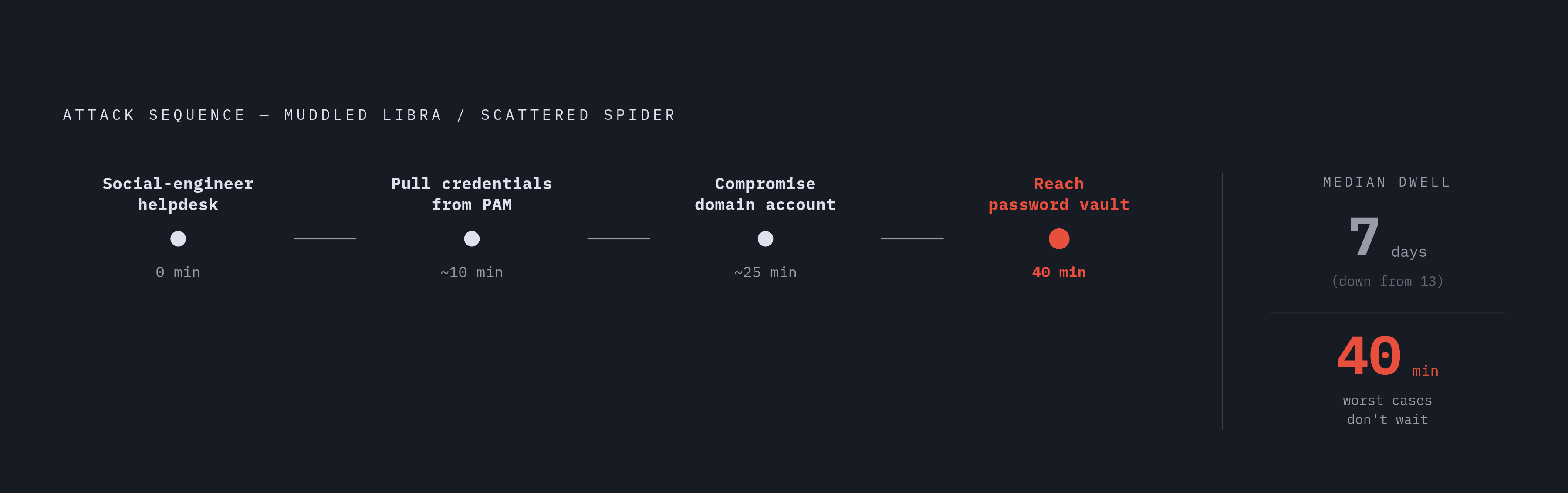
Dwell time has gotten shorter, which sounds like good news until the shape of the distribution comes into view. Palo Alto Networks' Unit 42 2025 IR Report put the median at 7 days, down from 13 the year before, but a median isn't a floor. Some intrusions compress the entire attack lifecycle into under an hour, and a phone tree doesn't survive that timeline no matter how well it's staffed.
Muddled Libra, also tracked as Scattered Spider, is the clearest case on record for what "under an hour" looks like in practice. The group social-engineered a service provider's helpdesk, pulled credentials from a privileged access manager, compromised a domain-privileged account, and reached a password vault. Total elapsed time: 40 minutes. The helpdesk agent who took the first call had no pre-set trigger for an unusual PAM access request, so it became a judgment call instead of an automatic escalation. By the time anyone made that call, the attacker already had domain access. Forty minutes leaves no room for a meeting about what counts as suspicious.
Third-party involvement in breaches doubled in the same reporting period, from 15% to 30% per the 2025 DBIR. Helpdesks and service-provider environments are now a named attack surface, and most escalation trees still treat a compromised vendor as an edge case instead of the fastest-growing scenario in the data. That's the single most common blind spot in trees built more than a year ago.
If the response depends on someone figuring out who to call after the alert fires, the window has already started closing. No amount of talent on that call fixes a plan that begins with "let me find out who handles this."
How the P1–P4 severity matrix gives every alert a pre-made answer
The standard model crosses four impact levels (catastrophic, major, minor, trivial) with three urgency levels (high, medium, low) to produce four priority tiers. Plain-language labels, Critical, High, Medium, Low, beat bare P-codes whenever non-technical staff take part in response. A label communicates meaning on sight; a P-code requires someone to remember what P2 meant last quarter, which is one more decision a stressed office manager shouldn't have to make mid-incident.
What counts as P1 has to be spelled out in security terms, never left as an abstraction: confirmed compromise of business-critical infrastructure, active ransomware encryption, confirmed exposure of administrative credentials, confirmed exposure of regulated data (PII, payment card data, health records, financial data), active insider threat with privileged access. Each of those is concrete enough that someone with zero security background can recognize it without interpreting it first.
Attach service-level commitments to each tier and the judgment call disappears. P1 gets a response within one hour and resolution within four. P2: two hours to respond, eight to resolve. P3: resolution within twenty-four hours. P4: resolution within seventy-two hours. Those numbers are the pre-made commitment that erases any need to negotiate urgency in the moment, and negotiating urgency in the moment is what kills response time.
None of this works unless it's applied identically every time; consistency is the entire mechanism, and the labels are just the interface. False positives deserve the same discipline as real ones: confirm an event isn't real, document it, close it. Escalating a false positive burns the same analyst hour a genuine P1 needs, and it teaches the team to treat every alert as noise, which is how the real signal gets missed three weeks later.
The two escalation paths and when each one applies
Two distinct paths exist, and conflating them is where most escalation trees quietly fall apart.
Hierarchical escalation moves up the management chain: agent to supervisor to manager. It applies whenever the decision is really about authorization, shutting down a system, approving external notification, bringing in legal counsel. It puts the decision in front of someone who can approve action outside normal operating limits, which is the entire point of the path.
Functional escalation transfers the incident to whoever has the relevant expertise, rank aside. A potential credential compromise goes to whoever manages identity, not necessarily anyone's manager, and a billing anomaly that smells like fraud goes to finance, not IT. Get this backwards and the incident sits with someone senior but unqualified, while the person who could actually diagnose it waits to be looped in. Identity compromise has been found in 40% of breaches, which is exactly why routing to whoever owns identity has to be the first move, well ahead of any conversation about who holds the authority to approve a response.
Most real incidents need both paths running at once: functional escalation to get the right expertise on the problem, hierarchical escalation to authorize whatever that expertise recommends. A lean team's tree has to name both explicitly, because the person with the technical answer and the person with the authority to act on it are almost never the same person. The SOC tier model, L1 to L2 to L3 to incident response, is the structured version of the same idea: each tier up carries deeper investigative authority and wider response scope, not just a fancier title.
What a minimum viable escalation tree looks like for a company with no security staff
Start with one question: who, right now, in writing, is authorized to make each of these calls? Declare a P1. Shut down a system. Notify affected customers or regulators. Engage outside counsel or a forensics firm. Approve, or more often refuse, ransom negotiation.
Leave any one of those unnamed and the call gets made by whoever happens to be standing there when the alert fires. That's how responses stall, and it's also how they swing the other way entirely, someone overreacting or underreacting because nobody ever told them where the line sat.
A workable minimum needs four named roles, and one person can hold more than one. An incident coordinator takes the first reports, owns communication, and triggers escalation; this could be the IT manager, the operations director, or the owner. Who it is matters less than the fact that it's written down. A technical responder investigates and acts on the system itself, internal IT or an outside provider. A business decision authority approves shutdowns, outside spending, and customer or regulator notification. A legal or compliance contact, outside counsel or an internal compliance lead, runs the regulatory notification clock.
Below that layer, early responders need no security expertise at all, only permission to act without proving anything first. An office manager should be able to escalate a server alert without confirming it's ransomware. A finance lead who spots a suspicious invoice should hand it straight to the coordinator instead of investigating solo; the moment anyone starts investigating alone instead of escalating, the clock the tree exists to protect starts running unwatched. The job for anyone who spots something stays simple: record what happened, preserve the original evidence, notify the coordinator.
The contact list itself has to live somewhere reachable when email is down: a printed copy, an out-of-band messaging channel, ideally both. There's a secondary payoff worth naming here too. A written plan reduces friction with cyber insurers and supports compliance obligations under applicable regulatory frameworks, which makes the investment easier to justify before an incident than after one. Consolidating device management, endpoint security, and identity into fewer platforms also cuts the number of alert sources a non-expert has to watch, and fewer tools means fewer ambiguous signals competing for the same tired attention.
How to calibrate the tree across a portfolio of clients or business units
Severity doesn't travel, and treating it as if it does is the most common design flaw in a multi-client tree. A credential exposure that's a P2 for a company holding no regulated data is a P1 for one holding health records. Copy one client's tree onto another client's environment and the severity matrix stops meaning anything the moment it's pasted in.
Three things stay client-specific in every tree across a portfolio: the P1 definition, anchored to that client's actual critical systems and data types; the business decision authority, plus how to reach that person outside business hours; and the regulatory notification timeline, which shifts by jurisdiction and by the category of data involved.
Three things standardize without losing accuracy: the severity matrix structure and its SLA benchmarks, the two escalation path types, and the documentation format and communication templates. Standardize the scaffolding, customize the content, and portfolio management stops requiring a rebuilt framework for every new account.
A quarterly review keeps the whole thing honest. Pull every P1 and P2 from the previous quarter and ask, in hindsight, whether the classification held up, flagging the P3s that should have escalated sooner and the P1s that turned out overclassified. That output feeds straight into rule tuning, runbook updates, and training, so the tree sharpens with each cycle instead of going stale on a shared drive nobody opens.
Established frameworks like NIST SP 800-61r3 do real work for prioritizing across a portfolio without requiring a custom framework per account. The supply-chain angle can't stay an afterthought either. With third-party involvement in breaches having doubled to 30%, up from 15%, every client-specific tree needs a named contact for the scenario where the incident starts at a vendor, not inside the client's own environment.
The organizational cost of not pre-making these decisions
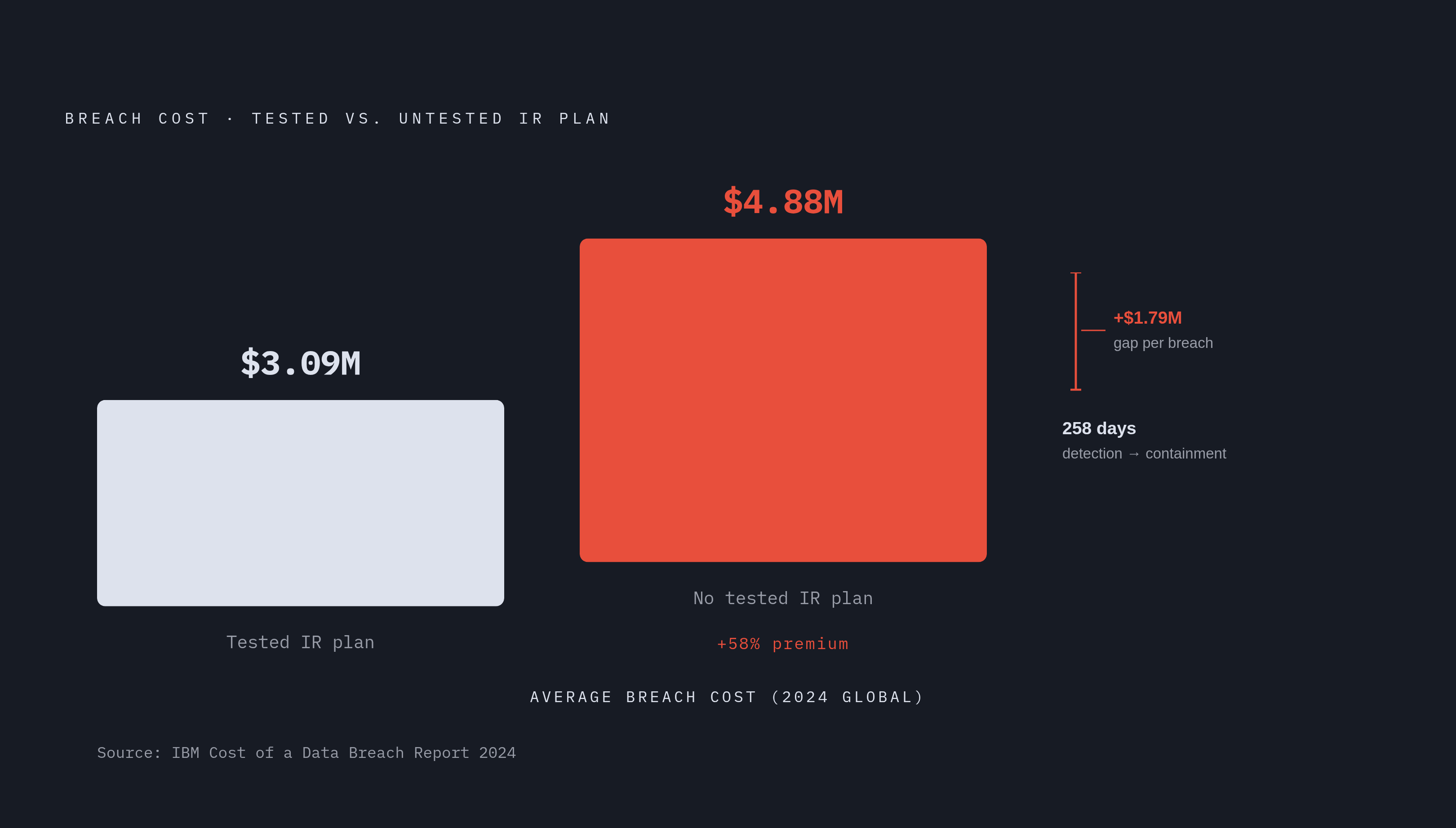
The cost of skipping this work is documented, not theoretical. Companies without a tested incident response plan paid 58% more per breach than those with one, according to Exabeam research, and the average breach ran 258 days from detection to containment. That's most of a year spent inside a compromised environment, waiting on decisions that could have been written down in an afternoon.
Averages hide the part that matters most here. The 2024 global average cost of a data breach, $4.88 million, spans companies of every size; for a large enterprise, that figure is a bad quarter. A breach of that magnitude is often the end of the business for an SMB, full stop, with no recovery quarter to plan for.
The talent market makes none of this easier. ISACA's 2025 report found 65% of organizations have unfilled cybersecurity positions, and per the World Economic Forum, only 14% feel confident they have the people and skills they need today. That gap isn't closing soon, which means the escalation tree has to absorb more of the judgment a trained analyst would otherwise supply live, precisely because that analyst frequently doesn't exist on staff.
A pre-built tree stands between a company and a set of grim defaults: a 258-day containment window, a missed legal notification deadline, a privileged access manager compromised while a helpdesk agent waited for someone to tell them what an unusual request looks like. Leading security frameworks have made the underlying point explicit: cybersecurity is a business management responsibility, not a technical afterthought delegated downward. An escalation tree is how that governance principle turns into something a team with no security department can actually run day to day.
The real test of any escalation tree is simple to state, if not always simple to build. Does it eliminate every decision that could have been made in advance, leaving human judgment for the genuinely new situations no process could have anticipated? Everything else should already have an answer waiting, written down, before the alert ever fires.