Threat Intelligence Feeds Calibrated for SMB Client Portfolios
Smaller businesses need threat feeds tuned to their actual capacity, not enterprise-grade noise.
Small businesses got hit with 43% of all cyberattacks in 2025, and that number isn't an accident of scale. It's a targeting decision. Attackers go after SMBs because they're easier to get into, not because there's more money on the other side. This piece breaks down what that attack surface actually looks like, why most threat intelligence feeds miss the mark for smaller shops, and which options actually fit an SMB's real operating capacity.
What the actual attack surface looks like for a typical SMB in 2025
Credential abuse is the front door. Over 80% of breaches tracked in the Guardz Mid-Year 2025 SMB Threat Report involved a stolen or compromised password, whether through password spraying, credential stuffing, MFA bypass, abuse of legacy authentication protocols, or plain account takeover. Cloud platforms are where most of this plays out now. Microsoft 365 environments saw the heaviest concentration of attacks, with Google Workspace not far behind, and login portals for both saw password attacks spike hard through the first half of the year.
Unpatched software is the other major lever. Vulnerability exploitation drove 20% of breaches per an industry data breach report, up 34% year over year, and 32% of ransomware incidents started with an exploited vulnerability. Edge devices, the VPNs and firewalls sitting at the network perimeter, went from 3% to 22% of exploitation targets over two years, an eight-fold jump, according to the Securafy Cybersecurity Buyers Guide. Third-party involvement in breaches doubled to 30% in a single year per Verizon, meaning SMBs increasingly get hit not for their own data but as the soft link into someone else's supply chain.
Phishing has changed shape too. AI-written phishing now makes up 82.6% of detected phishing emails, up 53.5% year over year, and AI-enabled fraud jumped 1,210% in 2025 (Securafy). That's landing on a workforce that mostly isn't trained for it: fewer than 25% of small businesses run regular security training, and separate figures put 58% of employees unable to spot a phishing email and 63% reusing passwords across platforms. Ransomware itself has evolved past simple encryption. 87% of attacks now involve data exfiltration, setting up double extortion, and Guardz logged close to 100 distinct ransomware detections among SMBs in just the first half of 2025. That's not one threat. It's dozens of fast-mutating ones.
Boil it down and three vectors account for most of the risk: stolen credentials, cloud exploitation, and unpatched software. Everything else is secondary.
What a threat intelligence feed is, and what it is not
A feed is raw data. IP addresses, file hashes, malicious domains, delivered on a schedule, usually automated. Intelligence is what happens after that: the decision made because of the data. A feed tells you an address is malicious. Intelligence tells you why that matters to your organization specifically, and what to do about it.
There are three tiers, and the difference matters a lot for a small business trying to figure out where to spend time.
Tactical intelligence is the fast stuff: lists of IPs, hashes, URLs, updated constantly, useful mainly to automated tools because the shelf life runs hours to days. Attackers rotate infrastructure so often that most of this decays before a human ever reads it. Operational intelligence moves slower and lasts longer, weeks to months, and it's about how attackers work rather than what server they used last Tuesday. Strategic intelligence sits above both: sector-level risk trends, ransomware economics, geopolitical targeting patterns, meant for owners and leadership making risk and spending decisions.
There's a concept in the field called the Pyramid of Pain that explains why this hierarchy matters: an attacker can change an IP address in minutes, but changing an entire method of attack takes months. That means an SMB gets far more defensive value per hour spent on operational intelligence than on chasing tactical indicators. The common mistake is subscribing to a tactical feed, piping it into some tool, and calling that a security program. Calling that a security program does not make it one. It's a subscription.
Feeds arrive in different formats too, human-readable reports, automated data streams, or structured formats like STIX, CSV, JSON, and OpenIoC that plug straight into security tooling. Not every tool speaks every format. Intrusion detection systems, EDR, XDR, and SIEM platforms can all get sharper with a good feed behind them, but only if someone, or something, is actually acting on what comes out the other end.
Why enterprise-grade feeds generate noise rather than protection for SMBs
Enterprise feeds get built for enterprise SOC teams: analysts triaging alerts all day, correlation tools running in the background, playbooks that spell out exactly what to do when an alert fires. Almost none of that exists inside a typical small business.
Stack fragmentation makes it worse before it makes it better. Guardz found that 77% of MSPs run between 4 and 10 separate cybersecurity point solutions for their SMB customers. Dropping a raw threat feed into a stack that's already fragmented doesn't add clarity, it adds another source of alerts nobody's watching. Then there's sheer volume: AlienVault's Open Threat Exchange processes an enormous volume of indicator records daily. An SMB without a dedicated analyst can't triage a meaningful slice of that, and bulk tactical feeds just pile onto a heap that's already too tall to climb.
Language is its own barrier. Most threat intelligence reports get written for practitioners, full of TTP references, CVE numbers, and actor attribution that mean nothing to a founder or a generalist IT person without a lot of added context.
A readiness threshold governs all of this, and feeds only pay off once an SMB clears it:
- No asset inventory means there's no way to tell if a flagged system is even yours.
- No tested backups means threat awareness alone won't get you back online.
- No documented incident response plan means feed alerts just sit there, unactioned.
- No MFA on external services means the most common way in stays wide open no matter how good the feed is.
Below that line, a feed is a distraction. It generates noise nobody can act on and creates a false sense that a CTI program exists when what's really running is a subscription nobody's using. None of this is a knock on the feed vendors. Enterprise feeds do exactly what they were built to do. They just weren't built for this buyer.
What "calibrated" means: the filtering logic that makes threat intelligence usable at SMB scale
Calibration starts before anyone signs up for anything. It starts with Priority Intelligence Requirements, or PIRs: specific, answerable questions that define what the intelligence practice is even for. "Which ransomware groups are currently targeting businesses in our industry and revenue range?" is a PIR. Every piece of intelligence coming in should get tested against questions like that one. If it doesn't answer a PIR, it's noise, full stop, regardless of how technically accurate it is. Writing PIRs costs nothing, and it should happen before a feed gets chosen, not after.
Calibration by threat surface follows naturally from that. Given that credential abuse, cloud exploitation, and unpatched software drive most SMB incidents, a calibrated feed weights those three heavily and pushes nation-state activity, zero-day exploit chains, and infrastructure-scale DDoS patterns way down the list. Those things matter enormously to a large enterprise. They're mostly irrelevant to a 30-person accounting firm.
Sector and geography narrow things further. Filtering a feed to a specific industry and region produces fewer indicators, but far more relevant ones. "Which ransomware groups are targeting healthcare SMBs in our region?" beats a global ransomware watchlist every time, because it's a question someone can actually answer.
Output format matters just as much as content. A feed built for SMB use answers three things in plain language for every finding: what happened, why it matters to a business like this one, and what to do next. Raw indicator lists dumped on a non-practitioner accomplish nothing. And on weighting, a calibrated feed leans operational over tactical, because attacker behavior shifts slowly while IP blocklists go stale in hours. None of this is a one-time setup, either. As the business adds cloud tools, hires staff, or brings on new vendors, the PIRs need revisiting.
Free and low-cost feed options that work at SMB scale, and what each covers
AlienVault OTX (Open Threat Exchange) is free, crowd-sourced, and enormous, processing a large volume of indicator records daily. It outputs in structured formats, which means it only works well for an SMB that already has a tool capable of ingesting them. On its own, without integration, it's not much use. Sector-specific feeds are available within it, which helps narrow the flood.
MISP (MISP Threat Sharing, formerly Malware Information Sharing Platform). An open-source platform built for sharing and correlating indicators across organizations. Useful for correlation work, but it takes real technical setup, better suited to an IT generalist on staff than to a non-technical owner trying to configure it solo.
Shodan is a search engine for internet-connected devices. Point it at your own organization and it shows what's visible and reachable from the open internet right now. Worth using before picking any feed at all, since knowing the external attack surface is a prerequisite for knowing which indicators are even worth caring about.
It requires minimal configuration, returns an immediate answer, and addresses credential exposure directly.
theHarvester maps the public information an attacker could gather during pre-attack reconnaissance, domains, emails, subdomains, whatever's exposed. Useful for seeing the organization the way an attacker sees it, before deciding what feed coverage actually matters.
The limitation across every one of these tools isn't data quality. It's what happens next. Free feeds still need a process behind them, someone or something that acts on what gets surfaced. Without that process, free tools produce the same noise as the enterprise feeds, just at a smaller, more manageable size.
Where threat feed investment fits in the SMB security priority stack
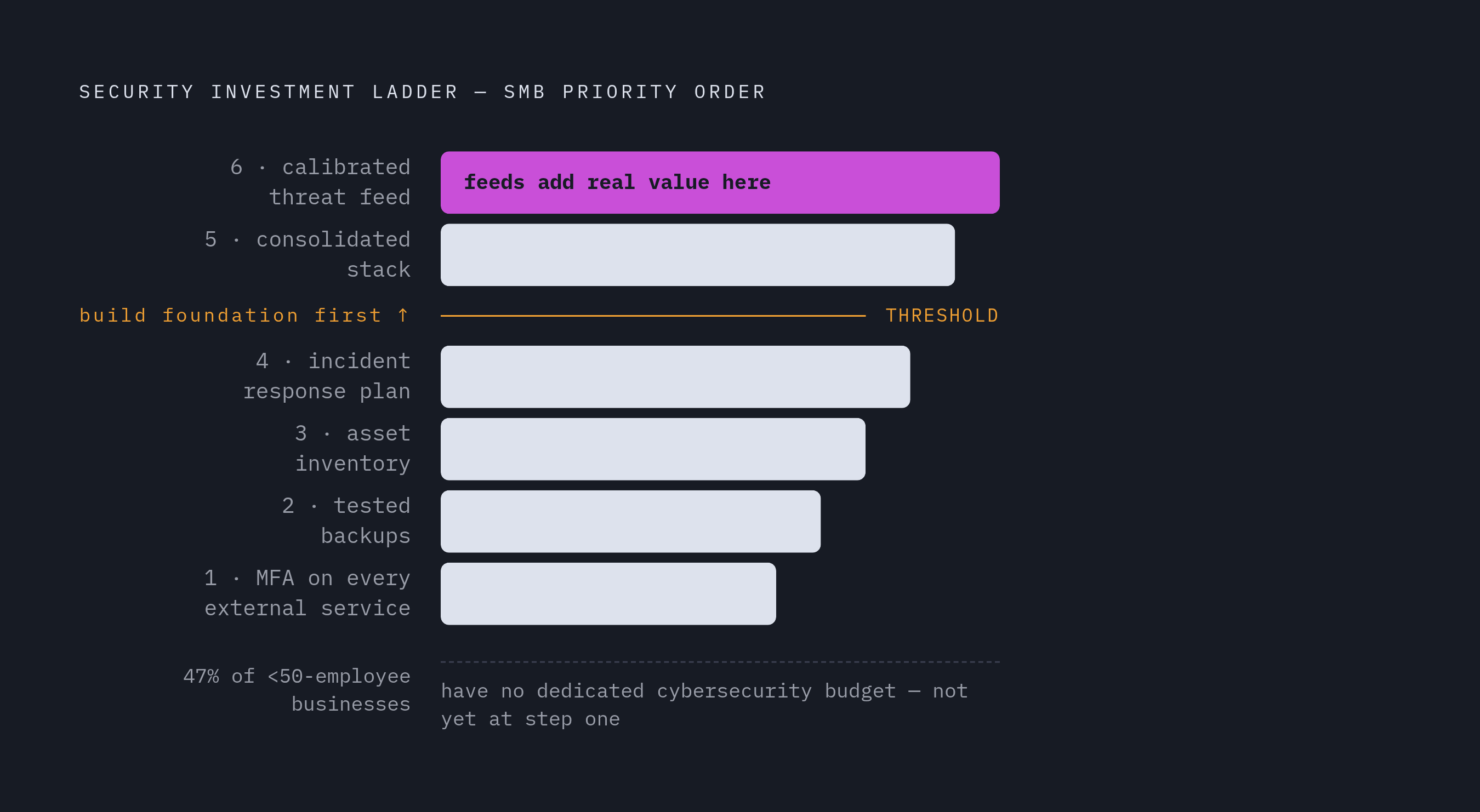
Feeds amplify a working security foundation. They don't replace one. MFA on every external service, tested backups, an actual asset inventory, and a documented incident response plan (even a basic one) all deliver more protection per dollar than any feed subscription. And a large chunk of the market isn't even close to that baseline: 47% of businesses with fewer than 50 employees have no dedicated cybersecurity budget at all. For that group, a feed is the wrong first purchase, full stop.
Once the foundation is actually in place, feed value compounds fast. A flagged IP address means something once there's an asset inventory to check it against. A ransomware TTP alert means something once there's a response process ready to invoke. Before that, it's just information with nowhere to go.
Stack fragmentation is the other obstacle, and it's a big one. With 77% of SMBs running between 4 and 10 separate security point solutions, bolting a standalone feed onto that pile creates more correlation work, not less. The feed's value gets diluted by the noise of tools that don't talk to each other. What actually helps is the opposite: device management, endpoint security, identity protection, and threat intelligence running off one data model, so a flagged indicator gets automatically checked against known assets, active identities, and compliance state without a human doing that math by hand. For an SMB with no security team, that kind of integration, intelligence built into enforcement and alerting rather than sitting on a dashboard waiting for someone to read it, does more work than a raw feed ever will.
A rough decision frame for where any given SMB sits:
- No asset inventory, no MFA, no tested backups: build the foundation first.
- Foundation in place but the stack is fragmented: consolidate before adding a feed. Fragmentation cancels out whatever value the feed would add.
- Foundation in place, stack consolidated: this is where a calibrated feed, filtered to industry, region, and the top three attack vectors, starts adding real early-warning value.
A stark financial case drives all of this. Breach costs for small businesses typically run between $120,000 and $1.24 million, and 40% of SMBs say a $100,000 incident would put them out of business entirely, per the Verizon DBIR. Nineteen percent of attacked SMBs face bankruptcy outright, which makes this an existential question for a lot of businesses, not a line-item cost decision. Ransomware downtime alone costs roughly 50 times more than the ransom itself, and with recovery windows averaging 24 days according to research from Spacelift, the case for early warning isn't really about the price of the feed. It's about the weeks of downtime a well-timed alert might prevent.