Knowledge Management Systems for Multi-Client IR Teams
IR teams need knowledge systems that separate client secrets from shareable lessons.
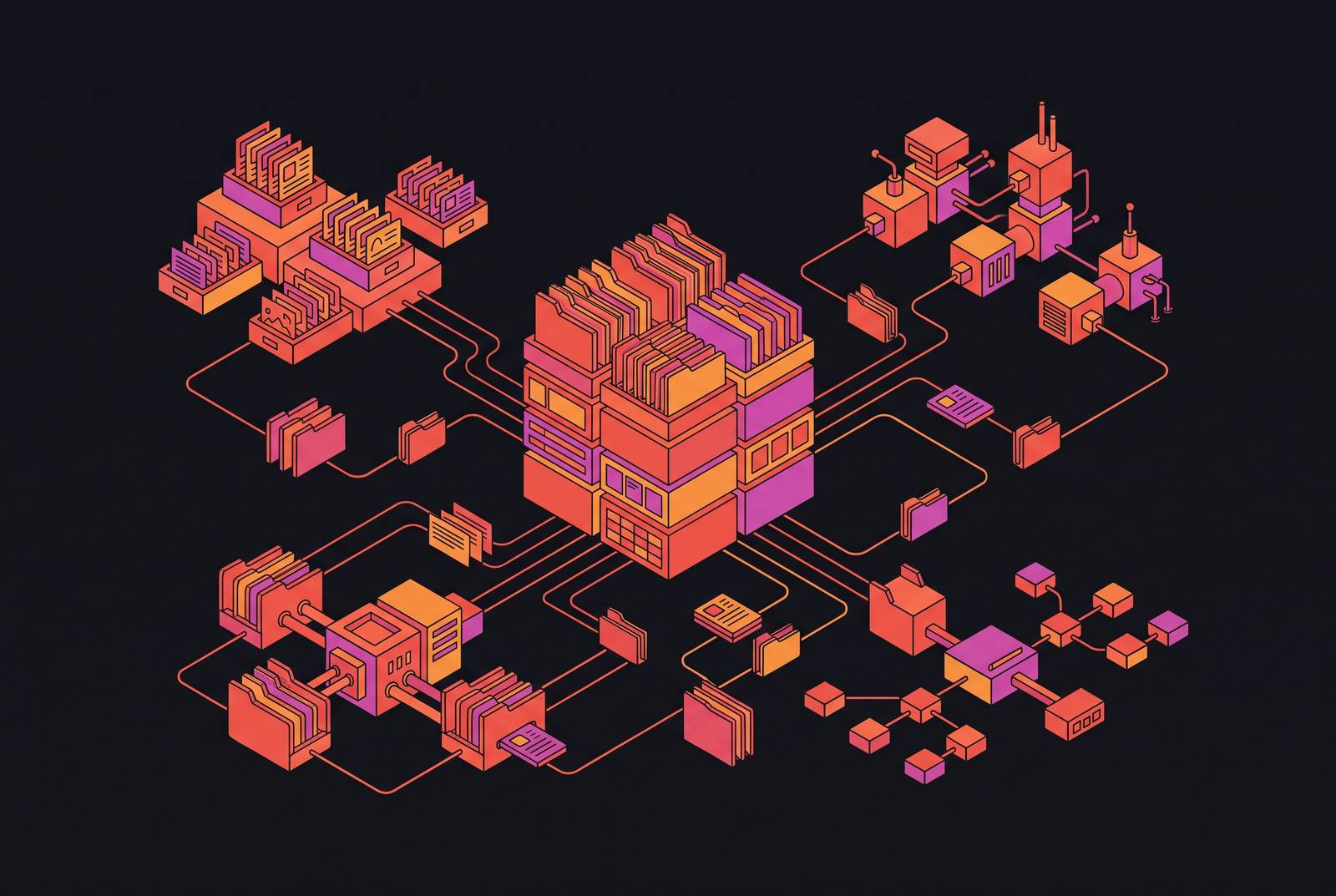
Multi-client incident response teams carry a split personality problem. Every engagement produces two kinds of knowledge that need almost opposite handling: client detail that has to stay locked inside one engagement, and general procedure that should get better and sharper every time the team runs a new case. Most knowledge management tools pick a side, either wide-open sharing or airtight isolation, and that's exactly why so many IR teams end up with knowledge scattered across three or four systems that don't talk to each other.
The result is predictable. An analyst on engagement fourteen has no way of knowing what the team figured out on engagement six, even though the incident type is nearly identical. The tooling functions correctly, but the design itself is worth taking apart piece by piece.
How the knowledge that IR teams generate actually divides into two distinct layers
Start with what actually gets created during a case. Some of it belongs to one client and one client only. Incident timelines, the list of affected systems, the exact threat actor behavior seen in that environment, the containment call and why it was made, legal holds, draft regulatory notifications, the final remediation report. None of that should ever touch another client's workspace. Call this layer one: client-contained.
Then there's the knowledge that has value precisely because it doesn't belong to anyone. A ransomware playbook. A runbook for isolating a compromised domain controller. A triage checklist for deciding how fast to escalate a BEC case. Lessons pulled out of a closed engagement, stripped of anything that would identify the client, and folded into how the team runs the next one. Call this layer two: transferable.
Here's the part most teams get wrong. Lessons-learned material doesn't start in layer two. It starts in layer one, as a raw observation tied to a specific client and a specific incident, and it has to get deliberately pulled out, cleaned up, and moved over. That move is a process, and it needs rules. Skip the rules, and analysts end up making that call on the fly, under time pressure, with no consistency and no way to audit it after the fact. One analyst shares too much. Another shares nothing at all, and a useful pattern just dies in a closed case file. A knowledge system built for this environment makes that boundary explicit and enforces it structurally, not something left to individual judgment in the middle of a busy week.
Permission architecture as the enforcing mechanism, not policy alone
Writing a confidentiality policy is easy. Getting an analyst to follow it at 2am during an active breach, when the fastest path is to paste something into a shared channel, is a different problem entirely. If the system lets someone search across client workspaces by default, cross-contamination is a matter of time, not risk. If dropping a file into the shared library takes fewer clicks than filing it under the right client, guess where it lands.
So permissions need to be built into the structure, not bolted on as a setting someone might forget to flip. A few things that actually matter here:
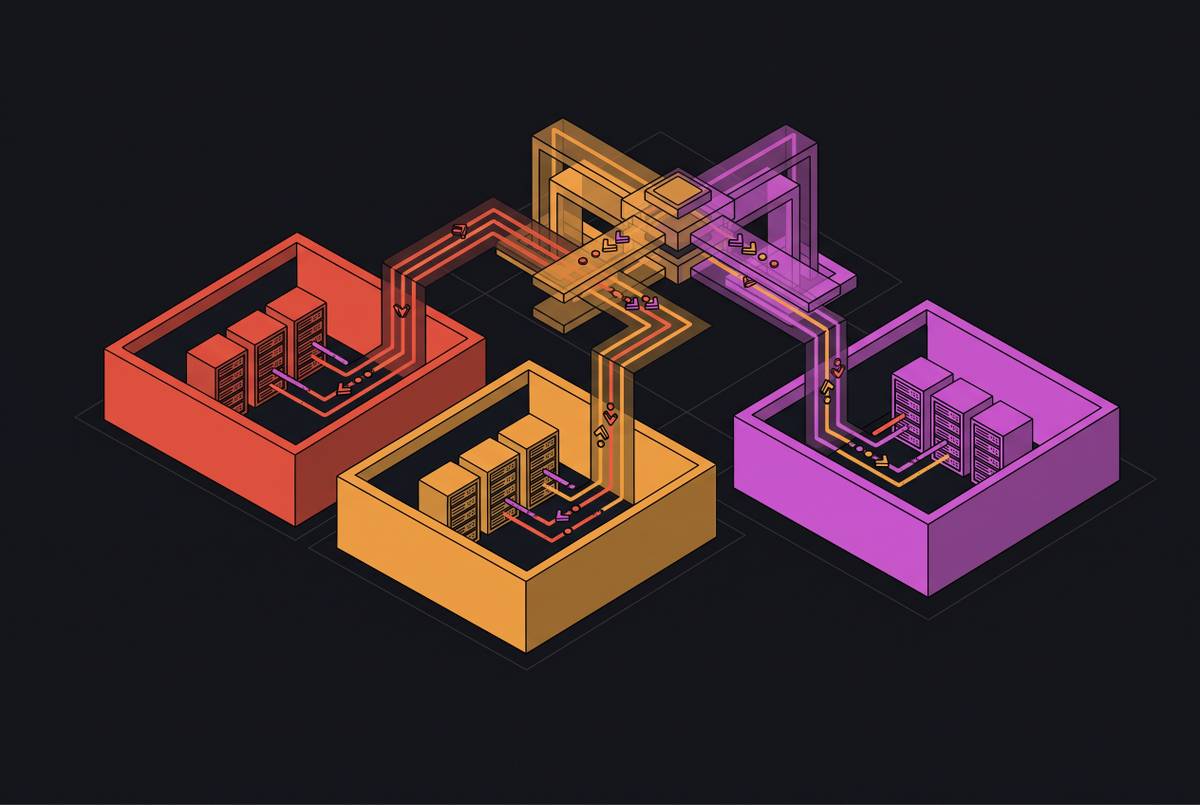
Client workspaces need to be separated at the architecture level, not just labeled differently inside one big shared space. Role-based access needs to work at the client level, not just at the platform level overall. Moving something from a client's private space into the shared library should require an actual permission grant, an approval step, not a drag-and-drop into a different folder. And every access needs a log: who opened which client's workspace, when, and what they touched while they were in there.
The question worth asking any vendor is blunt: does the platform structurally prevent cross-client access, or does it just rely on people tagging things correctly? Platforms designed for sensitive multi-client data environments treat data segregation as a formal, structural guarantee, not a best practice suggestion. IR teams need the same standard. And audit trails need to go past simple access logs. Who signed off on moving a lessons-learned item out of a client folder and into the shared library? Which version of the ransomware playbook was live during last month's engagement? When did anyone last check whether a runbook step still works?
The shared knowledge layer: how playbooks and runbooks compound without becoming stale
A shared playbook library is only worth something if analysts can trust what's in it. A stale containment step isn't a minor inconvenience, it's actively dangerous mid-incident. So the value of the shared layer depends entirely on whether it keeps growing and staying current, and that takes deliberate upkeep, not a folder that gets updated whenever someone remembers to.
Every closed engagement should produce at least one contribution back into the shared layer, whether that's a revised runbook step based on what actually worked, a new branch in a decision tree because this incident type hadn't come up before, or a footnote added to a playbook's assumptions because reality didn't match the original plan.
That only happens with real ownership. Every playbook needs a named owner and a review schedule, not a vague sense that "someone" keeps it updated. Version history needs to show what changed and why, not just a timestamp saying it was edited. And when a playbook gets revised, analysts need to actually confirm they've read the new version before their next case, not just have it sit in a folder they never open.
The freshness problem shows up in every knowledge system, but IR raises the stakes. An outdated step in a general reference doc is a minor annoyance. An outdated containment step in an active breach can let the breach run longer than it should have. Treat playbooks as living documents with clear triggers for review, not just a date on the calendar, and let those triggers include a new incident type the playbook never anticipated, a containment approach that failed and had to be improvised around mid-engagement, or a tool or regulatory change that quietly breaks a step nobody's revisited. Platforms with built-in content governance, ones that flag stale material automatically instead of counting on someone's memory, solve the "who's actually watching this" problem at scale.
The lessons-learned pipeline: governing the promotion from client-specific to shared
Most multi-client IR teams that struggle with knowledge management have the two pieces already: client workspaces on one side, a shared library on the other. What's missing is the process that moves knowledge from one to the other. Without it, one of two things happens. The shared library grows slowly and unreliably, so the compounding effect everyone wants never shows up. Or, worse, client-specific detail leaks into the shared layer disguised as a general observation, which is a confidentiality problem hiding inside a knowledge-sharing win.
Fixing this means building a real pipeline with distinct stages.
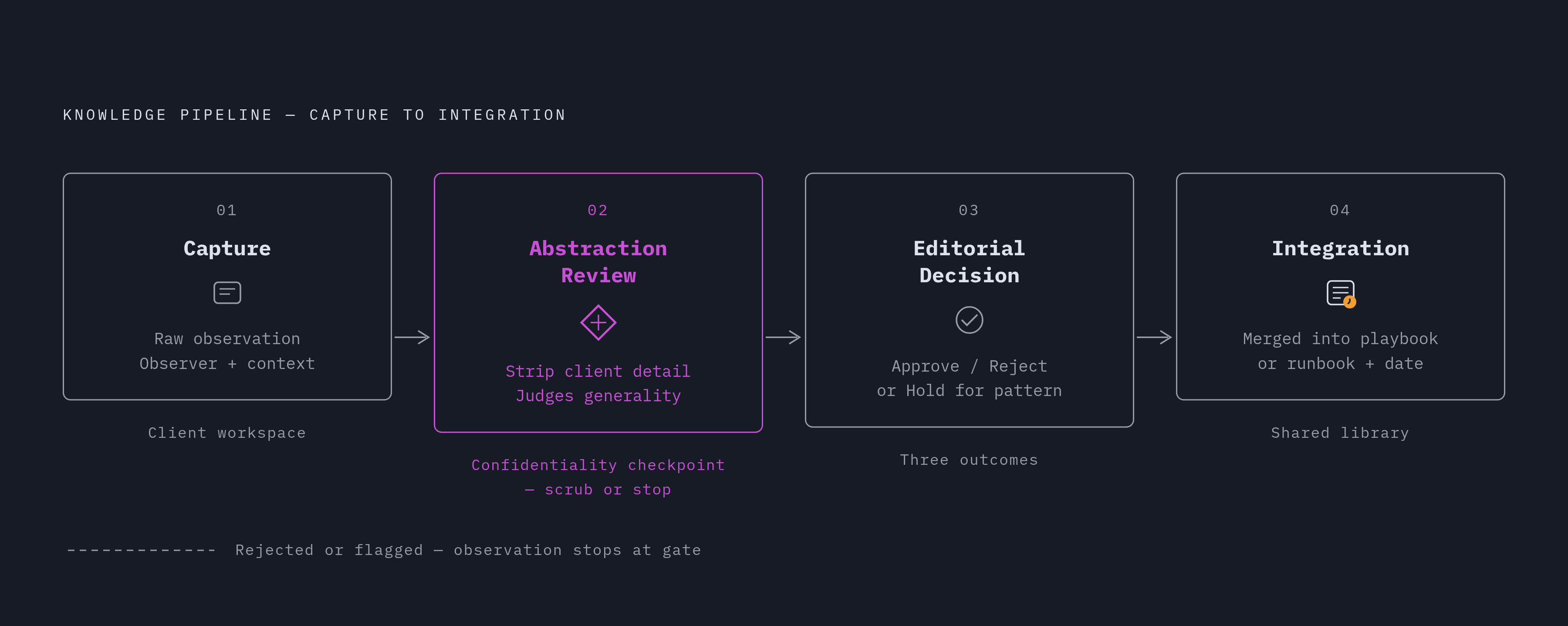
First, capture: someone writes down the raw observation in the client's workspace, close to when it happened, noting who observed it and in what context. Second, abstraction review: a named reviewer strips out anything that identifies the client and decides whether the observation actually generalizes to other engagements. Third, editorial decision: approve it for promotion, reject it, or hold it until the same pattern shows up in another case. Fourth, integration: the cleaned-up finding gets merged into the right playbook or runbook, with a date attached.
That second stage, abstraction review, is the confidentiality checkpoint. It's the point where client detail either gets scrubbed properly or the item doesn't move forward at all.
None of this works without ownership. If the person who captures an observation assumes someone else will abstract it later, it sits there indefinitely and never makes it into the shared layer. So assign it at the moment the engagement closes: one named person is responsible for carrying at least one observation all the way through the four stages before that engagement gets marked closed in the system. And there's a second payoff here beyond individual entries: when the same pattern shows up across several abstracted observations from different engagements, that's a signal the team needs a whole new playbook category, not just a tweak to an existing one.
Search and retrieval design for analysts who need answers in the middle of an active incident
The moment that matters most is the worst possible one: an analyst mid-containment needs a runbook step, or wants to know how a similar decision got made on a past case, and needs it now. A search box that only works if you already know the exact folder something's filed under fails at exactly the moment it's needed. And any search that can reach across client boundaries has to be blocked by the system itself, not just discouraged by a policy nobody reads under pressure.
For the shared layer, that means semantic search, not keyword matching and not relying on analysts to tag things consistently. An analyst typing "lateral movement through RDP with a compromised service account" should get relevant runbook steps even if that exact phrase never appears anywhere in the document. Research on AI-enabled knowledge systems has found search-time reductions as large as 35% in some studies, which in IR translates not to a mere productivity stat but to minutes that matter during containment.
The client-workspace layer needs the opposite design. There, speed matters less than completeness and order. An analyst reconstructing a timeline needs the full set of engagement artifacts in sequence, not just the single most relevant document a search algorithm decided to surface. Building one search experience for the shared layer, tuned for fast semantic lookup, and a separate one for the client layer, tuned for chronological completeness, beats trying to force one search model to do both jobs.
Platform selection criteria specific to the multi-client IR structure
The knowledge management software market overall is large, growing fast, and getting more crowded every year, according to Grand View Research figures putting it at $20.1 billion in 2024 with projections north of $60 billion by 2033. Almost none of that market was built with this specific problem in mind. Evaluating platforms on general feature depth, storage limits, integrations, UI polish, will lead a team to the wrong answer.
A better evaluation checklist looks like this:
Does the platform enforce client-workspace separation by architecture, or only through configuration someone has to set up correctly and maintain? Can an analyst with access to Client A's workspace search into Client B's workspace without an explicit grant, and does the platform actually block that, or just discourage it? Can permissions be set independently at the client level, the document level, and the content-type level? Does the platform support a real multi-stage promotion workflow with approval gates, or just a manual copy-paste between spaces? Is there full version history with a compare view, not just a "last edited" timestamp? Are audit logs exportable for compliance review? Does the platform flag stale content automatically, or does someone need to remember to check?
Different platforms serve different pieces of this puzzle well. Confluence handles structured documentation reasonably and has basic version history built in, though real version control at scale usually needs a third-party add-on, and space-level segregation takes deliberate setup rather than coming as a default. Guru's strength is in-workflow knowledge verification, which fits the shared playbook layer naturally, though its permission model needs a close look against the client-isolation requirement specifically. Notion offers a lot of flexibility and has been building out permission-aware semantic search, but how well client isolation holds up depends heavily on how disciplined the team is about workspace configuration. Platforms built around content governance, with scheduled reviews, acknowledgment tracking, and module-level access control, address the shared-layer maintenance problem directly, though client-workspace isolation still needs to be checked against the same segregation standard. And enterprise search tools built for permission-aware retrieval across dozens or hundreds of connected systems (one well-known example has raised $765 million at a $7.25 billion valuation) work well layered on top of an existing structured system, less well as the primary place content lives.
No platform on the market today was purpose-built for exactly this problem. The real question in vendor selection isn't which one has the most features, it's which one requires the least configuration override to actually meet the criteria above out of the box. And worth factoring in directly: a platform that takes months to configure before it enforces real isolation is exposed the entire time it's being set up, not just mildly inconvenient.
Implementation sequencing: what to build first and why the order matters
The mistake nearly every team makes is starting with content migration, moving existing documents into the new system before the permission architecture is actually in place. Files land in the wrong workspace. Client detail ends up somewhere it shouldn't. The migration itself becomes the exact cross-contamination event the new system was supposed to prevent in the first place.
Fixing a permission structure after content is already scattered across the system is a much harder job than building it correctly before a single document gets moved. Get the client-workspace boundaries and access rules locked down first. Build the promotion pipeline second, with real ownership assigned at each stage. Only after both of those are working should content migration start, one client engagement at a time, checked against the new structure as it goes in rather than dumped in bulk and sorted out later.