Building an Incident Escalation Plan for a Small Team
Cut response time by clarifying roles and decisions before crisis hits.
75% of small and mid-sized businesses have no incident response plan at all. That single number explains most of what goes wrong when something actually breaks: not a failure of technology, but a failure to decide, in advance, who does what when the alarm goes off. Organizations without a plan take an average of 258 days to contain a breach, compared to 189 days for those with one. Attackers don't pick targets by revenue size; they pick targets by opportunity, and an untested response plan is exactly the kind of gap that gets found. Small businesses paid an average of $2.98 million per breach in 2025, and companies without a formal, tested incident response plan paid 58% more per breach than those with one. This piece lays out how to build that structure before an incident forces the question, not during it.
Building an incident escalation plan for a small team with no existing process starts with four decisions made in advance: what counts as an incident, who owns each role, where critical data lives, and what communication channel the team uses if email is compromised. A working version fits on one page, with a named Incident Lead (and a backup), a Communications Owner authorized to speak externally, and a Technical Point of Contact who executes containment. Severity tiers, even a simple three-level model covering low, medium, and high, keep the team from either overreacting to a routine phishing report or underreacting to an active breach. The escalation path then answers one concrete question: when someone notices something wrong at 8pm on a Friday, what exactly do they do, in what order, and through which channel.
How fast incidents move and why improvisation fails at speed
The math here has changed fast. Median time between initial compromise and data exfiltration dropped from 9 days in 2022 to just 2 days by 2024. That compression means a team debating who has the authority to isolate a system is already losing ground while the debate happens. Every hour spent hesitating is an hour of additional access handed to whoever is already inside the network.
Meanwhile, detection itself lags badly: organizations take an average of 204 days to identify a breach in the first place, then another 73 days to contain it once it's found. Put those two numbers together and the picture gets uncomfortable. By the time a breach is obvious, it's often already weeks old, and the only variable a small team can actually control at that point is how fast containment happens once someone notices.
Noticing, in practice, rarely looks dramatic. A sales manager gets locked out of email. Files start renaming themselves. A customer says checkout looks strange. None of that screams "breach" on its own, which is precisely the problem: the gap between "something seems off" and "we know exactly who to call" is where a plan either earns its keep or collapses.
What the plan needs to answer before anything goes wrong
An incident response plan for a five-person company doesn't need to look like a binder written for a Fortune 500 security operations center. It needs to answer four questions clearly enough that a founder, an IT generalist, or an operations lead can act on it without guessing: What counts as an incident? Who does what, and when? Where does the important data actually live? And how does the team communicate when the usual channels can't be trusted?
That last point deserves a distinction most small teams miss. The plan itself covers responsibility and escalation, not technical procedure. Detailed steps for, say, isolating a compromised server or resetting a batch of credentials belong in a separate runbook. Conflating the two turns a one-page decision document into a fifty-page manual nobody opens under pressure.
And a plan that only exists as a file in a shared drive, reviewed once a year at best, isn't really a plan. It's a PDF. CISA's guidance for small businesses is refreshingly blunt on this: build a simple checklist covering who to call, how to report, and how to contain damage, and use it even when the incident turns out to be a false alarm. CISA also recommends naming a Security Program Manager, someone who owns the plan, keeps it current, and makes sure people know it exists. That person doesn't need a security background. They need to be the one everyone knows to ask.
A usable version of this fits on one page, with runbooks attached separately for anyone who needs the technical detail. If the escalation path can't be found in under a minute during a live incident, the document has already failed at its one job.
Defining what counts as an incident and setting severity levels
NIST defines a security incident as any occurrence that actually or potentially jeopardizes the confidentiality, integrity, or availability of a system or its data, or that violates (or threatens to violate) security policy. That's the correct legal and technical anchor, but it's not language a small team can act on in the moment.
Plain scenarios work better. A login from an unfamiliar country at 3am. A shared account someone tried and failed to access repeatedly. Files that won't open and can't be explained. A vendor calling to say their systems, which touch yours, look compromised. An employee admitting they clicked a link they shouldn't have.
Severity tiers turn those scenarios into action. Even a simple three-level model does the job: low (suspected, unconfirmed, no known exposure or operational impact), medium (confirmed unauthorized access or exposure, but contained in scope), and high (active attack, ransomware, confirmed exfiltration, or systems down). Without tiers, teams tend to swing between two failure modes: treating a routine phishing report like a five-alarm fire, or treating an actual breach like a Tuesday. CISA's advice to invoke the plan even on suspected false alarms holds up here, because the cost of a ten-minute drill is nothing next to the cost of a missed real incident.
Phishing sits at the center of this because it's the most common front door. It was the top reported cybercrime category in 2024, with over 193,000 complaints filed to the FBI's Internet Crime Complaint Center. For most small teams, the first escalation decision anyone ever makes will start with an employee admitting they clicked something.
Assigning roles when no one has "security" in their job title
Three roles cover the minimum a small team needs, and none of them require a security title to fill.
The Incident Lead runs the response. This person makes containment calls, owns the timeline, and coordinates everyone else, and needs a named backup, because incidents don't wait for someone's vacation to end. The Communications Owner is the only person authorized to speak externally, to customers, vendors, regulators, or insurers, which matters because conflicting messages during a fast-moving incident do real damage on their own. The Technical Point of Contact, whether an internal IT generalist or an outside partner, actually executes containment: isolating systems, disabling accounts, preserving logs.
Response involves more than the technical side, though. Leadership needs to understand risk thresholds well enough to authorize taking a system offline or notifying customers. Finance needs a documented protocol for handling suspicious payment requests, which matters given that business email compromise caused $2.77 billion in reported losses in 2024. Operations needs enough clarity to keep the business running around the disruption. Customer-facing staff need pre-approved language, not an improvised answer to "is my data safe" from someone who's guessing.
The failure that shows up again and again: roles get assumed rather than assigned. "IT handles it" sounds like a plan until two people each assume the other is calling the shots, and the actual decision, isolate the server or don't, sits untouched for forty minutes. CISA's Security Program Manager role overlaps neatly with the Incident Lead here for a small team; the title matters less than the fact that someone specific owns it. Every role needs a documented backup too, since key people go on vacation, travel for work, or simply aren't reachable at 11pm on a Saturday. A ransomware attack that lands on a holiday weekend is not a far-fetched scenario for a tabletop exercise; it's close to the median case.
One practical note: tools that surface alerts, device status, and identity activity in a single dashboard cut the cognitive load on a non-security Incident Lead considerably, since chasing the same information across five disconnected consoles costs exactly the kind of time an active incident doesn't allow.
How do you build an escalation path when you have no formal response process yet?
The escalation path exists to answer one very specific question: when a junior employee notices something wrong at 8pm on a Friday, what exactly do they do?
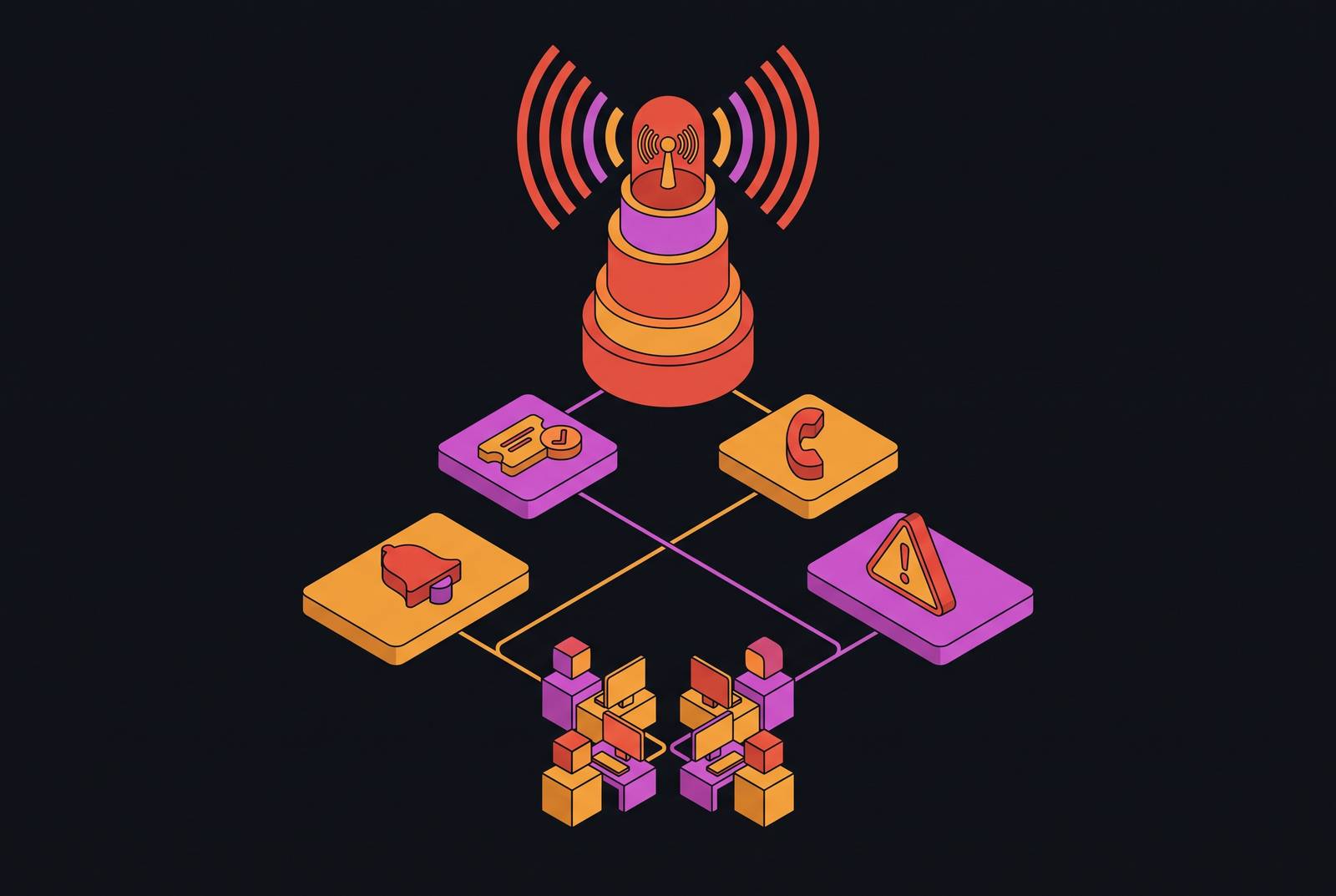
The answer needs to be a sequence, not a feeling. The employee who spots the issue documents what they saw, notes the time, and stops there, no further clicking, no attempted fix, just a notification to the Incident Lead. The Incident Lead assesses severity against the pre-defined tiers and, if it's medium or high, activates the plan. From there, the Incident Lead notifies the Technical Point of Contact and the Communications Owner at the same time, not sequentially. Containment starts immediately, following the runbook, while the Communications Owner holds anything external until explicitly authorized. If severity warrants it, leadership gets pulled in for decisions with real consequences: shutting down a production system, notifying customers, filing a regulatory report.
One detail gets skipped constantly: what happens if email itself is compromised? A plan that only lists email as the notification channel has a blind spot exactly where it matters most. A backup channel, a group messaging app, a documented list of personal mobile numbers, needs to exist and be written down before it's needed, not improvised in the moment.
The contact list itself is infrastructure, not paperwork. It needs internal roles with personal cell numbers attached, plus external contacts: the cyber insurance provider, legal counsel, any outside IT or security partner, and whichever regulators apply. And decision authority has to be explicit on paper. Who can actually authorize taking a production system offline? Who signs off on telling customers their data may be exposed? A rule worth keeping in mind: if stopping the bleeding requires three separate approvals, there isn't really an incident response process, there's a committee. Tying this back to asset inventory work done in advance matters too: knowing which systems and data matter most before the incident happens tells the Incident Lead exactly what to protect first when there's no time to figure it out live.
What to do and not do in the first hour of an active incident
The first hour is about containment, not investigation. The goal is stopping the spread, not understanding the full story, and confusing the two costs time the team doesn't have.
Immediate containment steps are straightforward: isolate affected systems from the network (disconnect them, don't power them down), disable any compromised accounts, block known malicious IPs or domains, and quarantine suspicious emails still sitting in inboxes.
That parenthetical about not powering down matters more than it looks. Wiping or rebuilding a system, or simply shutting it off, destroys volatile evidence: running processes, memory state, logs that show exactly what happened and when. That evidence matters for the investigation itself, for legal defensibility down the line, and for regulatory reporting obligations that may require specifics the team won't have if the system's already been reimaged. Preserve first, clean up second.
While containment happens, the Incident Lead keeps a running log: timestamps, decisions made, who was told what and when. The Communications Owner drafts holding statements but sends nothing externally without explicit sign-off. And it's worth remembering that the trigger for all of this is often a person, not an automated alert; 68% of breaches involve some human element, a clicked link, a misconfiguration, someone reusing a password. The employee who reports it is often scared and unsure whether they caused something serious, and the plan needs to account for that, not just the technical response.
Ransomware gets its own line here because for small businesses, it isn't an edge case. It showed up in 88% of SMB breaches reviewed in the 2025 Verizon Data Breach Investigations Report, against 39% for larger organizations. The first-hour response to ransomware specifically should already be written into the plan: don't pay, don't wipe, do isolate. Deciding that in the moment, under pressure, with a countdown timer on a ransom note, is exactly the situation a plan exists to prevent.
External contacts the plan must include before an incident happens
The cyber insurance provider is usually the first external call that matters, and it's often the most time-sensitive one on the whole list. Many policies require notification within a specific window, and missing it can affect what the policy actually covers, so the number belongs directly in the plan, not buried in a policy document nobody can find at midnight.
Legal counsel comes next, for decisions about what must be disclosed, to whom, and by what deadline, particularly if employee or customer records are involved. The FBI's Internet Crime Complaint Center and CISA both actively want small businesses to report incidents; IC3 handles cybercrime reporting directly, and CISA's reporting channel feeds threat intelligence that benefits other organizations facing the same attackers.
Third-party involvement in breaches doubled from 15% to 30% between recent Verizon DBIR reports, which means an outside IT or security partner isn't a nice-to-have anymore, it's frequently part of the incident itself. Knowing exactly how to reach that partner fast matters as much as knowing how to reach anyone internal.
Regulatory contacts depend heavily on industry: health data triggers HIPAA obligations, payment card data triggers PCI requirements, and state breach notification laws vary enough that the plan should spell out which apply and what the clock looks like for each. The whole list, name, role, primary number, backup number, and the severity threshold that triggers the call, belongs on a printed page kept somewhere accessible even if the network is down. And the same backup-channel problem from earlier applies here too: if email is the only way the team normally reaches its vendors, that's a gap worth closing now.
Testing the plan before an incident tests it for you
A plan that's never been run through a tabletop exercise is still a theory. Walking through a fake scenario, a ransomware note appearing on a Saturday morning, a compromised vendor account touching shared systems, surfaces exactly the failures a document review never will.
Decision bottlenecks show up fast in a tabletop: someone realizes, mid-exercise, that no one actually knows who has authority to pull a production system offline. Role ambiguity shows up too, the moment two people admit they each assumed the other was making the call. And the backup communication channel gets tested for real, rather than assumed to work, which matters given how often the primary channel is the one that's compromised in the first place.
None of this requires an outside consultant or a formal red team engagement. It requires the team sitting down, running the scenario out loud, and writing down what broke. Every gap found in a tabletop is a gap closed before it costs $2.98 million and takes 258 days to clean up. That's the whole point of building the plan in the first place: not to survive a hypothetical, but to make sure the real one, whenever it lands, is boring.